In 2025, The Plus Korea Defense Industry Index ETF’s (KDEF) performance has been notable, supported by robust gains across its key constituent defense companies.
 Since its launch on February 4, 2025, KDEF has surged 139.26%* through September 30, 2025, underscoring robust interest in Korea’s fast-growing defense sector. Over the most recent six-month period, KDEF gained 99.16%, while Q2 alone saw a 20.30% jump, reflecting sustained momentum and heavy investor appetite for defense-related exposure. (Ultimus Fund Solutions) Much of this strength stems from the outsized earnings and expanding order books of its top holdings whose stellar corporate results continue to translate directly into ETF performance.
*The performance figure noted is attributable to favorable market conditions that are not likely sustainable or repeatable in the future. The performance data quoted represents past performance. Past performance does not guarantee future results. Investment return and principal value of an investment will fluctuate so that an investor’s shares, when redeemed, may be worth more or less than the original cost. Current performance may be lower or higher than the original cost. Returns for periods of less than one year are not annualized. Standardized performance data and most recent month-end performance data is available at plusetf.com/#fund-summary.
In the first half of 2025, South Korea’s major defense companies delivered blockbuster results: combined operating profits leapt 161% year-over-year to KRW (Korean Won) 2.3 trillion (≈ US$1.66 billion). [1] This surge already accounts for nearly 80% of their full-year 2024 operating profit base. Their combined revenues nearly doubled from KRW 9.9 trillion to KRW 19.2 trillion. [1]
These results tell a compelling story, one that resonates directly with the investment thesis behind KDEF. Let’s unpack why these corporate earnings matter and what to watch for going into Q4 and full-year 2025.
🔍 Breakdown: What’s Driving the Gains?
Among the top names in the sector:
- Hanwha Aerospace shone brightest, posting ~ $1 billion in operating profit in H1 2025, more than quadruple its prior year figure of $248 million fueled by international sales of its K239 Chunmoo Rocket Launcher. Its sales also more than tripled, reaching $8.2 billion. [1]
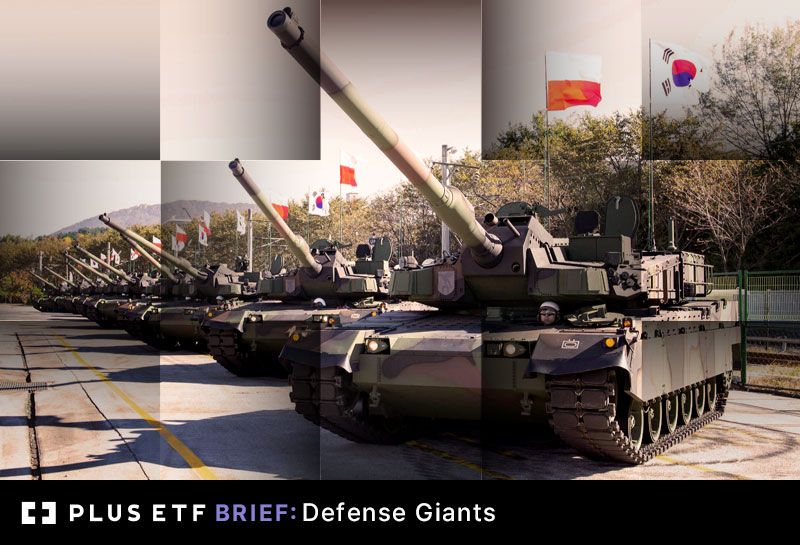
- Hyundai Rotem saw profits surge 192.4% ~ $ 322 million, with revenue rising 40% to $1.8 billion thanks to high margins in its Defense Solutions Division and K2 Tank exports. [1]
- LIG Nex1 achieved a 64.6% jump in operating profit ($134 million), supported by a 35.4% increase in sales to $1.3 billion driven by sales to Iraq for the Cheongung II missile system and exports to the UAE for the KM-SAM II systems. [1][5]
- Korea Aerospace Industries (KAI) delivered $92.4 million in operating profit (up 7.9%) due to exports of FA-50 fighter jets to Poland and Malaysia. [1]
- Hanwha Systems bucked the trend, seeing profit decline 29.5% even though its sales rose 18.4% boosted by deliveries of multifunction radars used in the Cheongung -II medium-range surface-to-air missile system to the United Arab Emirates and Saudi Arabia. [1]
What powered this surge?
Much of it stemmed from strong export deals and rising global defense demand amid geopolitical uncertainty. (Source 2) As a sign of how pronounced the global demand is, South Korea now ranks among the top 10 arms exporters globally, accounting for about 2.2% of global arms trade. [3] Analysts forecast more room to grow: the four major defense groups are projected to hit ~12.8 % operating margin by 2025, closing in on margins seen by U.S. peers. [4]
Order backlogs are also healthy and combined orders across these firms stood at $78 billion by mid-2025. [1]
The KDEF Connection: Earnings to ETF Valuation
KDEF is a passively managed fund tracking the Korea Defense Industry Index. It holds 24 constituent companies, with Hanwha Aerospace, Hyundai Rotem, HJ Shipbuilding & Construction, KAI and LIG Nex1 among the largest weights (as of 10/10/25). With major holdings directly in these high-growth defense companies, KDEF’s performance is tightly correlated to their earnings momentum.
Here’s why earnings matter:
- Earnings drive multiples: when companies post strong results and increased visibility into defense order growth, investors may assign higher valuation multiples to the sector.
- Momentum & sentiment: blockbuster results often attract flows and risk-on sentiment, particularly in thematic ETFs.
- Rebalancing and index weighting: as these firms grow in market cap, their weight in the underlying defense index may increase (subject to index methodology), further amplifying gains in the ETF.
Looking Ahead:
- Q3 / YTD earnings releases from the core names particularly whether export growth sustains vs. margin pressure
- New export contracts and order book updates, especially in Europe, the Middle East, and emerging defense buyers
- Valuation multiples across the sector
- ETF flows & sentiment toward defense/security tech themes globally
In sum, the blistering first-half performance of South Korea’s defense giants provided both the engine of KDEF’s growth and the lens through which to gauge its future potential. With export contracts accelerating, global defense budgets expanding, and investors increasingly drawn to security-themed assets, KDEF stands at a pivotal moment. If its core holdings can sustain their earnings power through the second half of 2025, the ETF could potentially continue to convert Korea’s industrial strength into market returns making it not just a reflection of national defense prowess, but a proxy for one of Asia’s most powerful new investment narratives.
To learn about about KDEF and see a full list of holdings, click here.
[1] Min-Ji, Jin, Defense Firms Report Strong H1 Earnings On Large Export Deals, Korea JoonAng Daily, 8/17/25.
[2] Lane, Issac, South Korea’s Defense Spending Surge: Strategic Investment Opportunities Geopolitically Sensitve Era, AInvest, 9/30/25.
[3] Ji-Eun, Seo, Ukraine ranks top arms buyer, South Korea slips into top 10 sellers, Korea JoonAng Daily, 3/10/25.
[4] De Alba, Teresa, South Korea’s Defense Giants to Hit US $28 Billion in 2025 Sales, Mexico Business News, 10/2/25.
[5] Jeong, Dong-ho, LIG Nex1 (079550 KS/Buy)1Q25 OP beats consensus by 75%, Mirae Asset Securities, 5/9/25.
Some of the companies highlighted herein are holdings of the PLUS Korean Defense Industry Index ETF portfolio. Please see plusetf.com/#fund-summary for complete holdings information. Holdings are subject to change.
Investors should consider the investment objectives, risks, charges and expenses carefully before investing. For a prospectus or summary prospectus with this and other information about the Fund, please call 1-855-900-0030 or visit our website at www.plusetf.com. Read the prospectus or summary prospectus carefully before investing.
Holdings are subject to change. For current holdings go to www.plusetf.com.
The Fund is distributed by Foreside Fund Services, LLC and Exchange Traded Concepts, LLC serves as the investment advisor of the funds. Foreside Fund Services, LLC is not affiliated with Exchange Traded Concepts, LLC or any of its affiliates.
Risk Disclosures:
Investing involves risk, including possible loss of principal. There is no guarantee the Fund will achieve their stated objectives. In addition to the normal risks associated with investing, international investments may involve the risk of capital loss from unfavorable fluctuation in currency values, differences in generally accepted accounting principles or social, economic or political instability in other nations. Emerging markets involve heightened risks related to the same factors as well as increased volatility and lower trading volume. The Fund’s concentration in an industry or sector can increase the impact of, and potential losses associated with, the risks from investing in those industries/sectors.
The Fund’s concentration in a single country or a limited number of countries will increase the impact of, and potential losses associated with, the risks from investing in those countries.
The Fund is non-diversified. The Fund is new and has a limited operating history for investors to evaluate. A new and smaller fund may not attract sufficient assets to achieve investment and trading efficiencies. In addition to the normal risks associated with investing, investments in smaller companies typically exhibit higher volatility.
The Fund may invest in securities denominated in foreign currencies. Because the Fund's NAV is determined in U.S. dollars, the Fund's NAV could decline if currencies of the underlying securities depreciate against the U.S. dollar or if there are delays or limits on repatriation of such currencies. Currency exchange rates can be very volatile and can change quickly and unpredictably.
The Fund is a recently organized investment company with no operating history. As a result, prospective investors have no track record or history on which to base their investment decision. Moreover, investors will not be able to evaluate the Fund against one or more comparable funds on the basis of relative performance until the Funds has established a track record.
One basis point (bps) is equivalent to 0.01%.


