South Korea's defense industry has been one of the defining growth stories in global markets over the past three years. A roughly $69 billion order backlog across the country's four largest contractors1, a roughly fivefold expansion in export volumes since 2020-20252, and a stated national ambition to become the world's fourth-largest arms exporter by 20303 have combined to put Korean defense manufacturers on the radar of institutional allocators worldwide. For investors and advisors weighing exposure to this theme, the current environment may present a setup worth examining closely: a sector with intact structural tailwinds, now trading meaningfully below its own recent highs.
From Peak to Reset
The rally that carried names like Hanwha Aerospace, Hyundai Rotem, Korea Aerospace Industries, and LIG Nex1 (all holdings as of 8/20/26) to record valuations earlier in 2026 has given way to a substantial correction. Leading holdings have pulled back 30% to 40% or more from their spring highs, driven not by a change in the underlying demand picture but by near-term uncertainty around geopolitical events and the timing of large export contracts, including tank and missile-defense deals under negotiation in Iraq and Peru.4
That pullback has materially changed the valuation picture across several of Korea’s leading defense companies; a shift that is clearly visible within the PLUS Korea Defense Industry Index ETF (KDEF). Hanwha Aerospace, the fund's largest position, has continued signing new business straight through the correction: a roughly $638 million follow-on K9 howitzer contract with Finland in April, a teaming agreement to localize K9 production in the UAE in June, and a contract under negotiation with Spain tied to a roughly $4.5-$7.2 billion artillery modernization program.5,6,7 Hyundai Rotem, KDEF's second-largest holding, delivered on its $6.5 billion second-batch K2 tank agreement with Poland this spring and signed a local-production pact with Poland's Bumar-Łabędy in April, laying the groundwork for the first K2 assembly line outside Korea, while a separate framework for roughly $2 billion in K2 tanks and armored vehicles with Peru moved toward finalization.8,9,10 LIG Defense & Aerospace, a smaller but strategically important holding, added its first export of the Haegung ship-based air defense missile to Malaysia in April, building on its earlier $2.8 billion Cheongung-II contract with Iraq.11,12
None of that reads like a sector whose fundamentals are broken. Order backlogs remain robust, and the drivers behind the sector's growth such as rising European defense budgets, sustained demand for NATO-standard equipment, and Korea's demonstrated ability to deliver at scale and speed, have not changed. What has changed is price. Korean brokerages have increasingly characterized the pullback as a reset in valuation rather than a reset in thesis, with several analysts noting that the correction has meaningfully improved entry points ahead of anticipated second-half order announcements.
Potential Signs of Renewed Strength
Recent price action suggests the market may be reaching that inflection point. Several of the sector's largest names have shown renewed strength in early August, with technical indicators and analyst sentiment turning more constructive after weeks of consolidation. LIG Defense & Aerospace jumped more than 9% in early August13, and Hanwha Aerospace now carries a Strong Buy consensus from 23 analysts, with price targets implying meaningful potential upside.14
These are early data points rather than a confirmed trend, and analyst price targets are estimates, not guarantees, of future performance. Taken together with the broader sell-side commentary on the sector's valuation reset, however, they are consistent with the view that the summer correction reflected near-term uncertainty over contract timing and geopolitics in the middle east rather than a change in the sector's underlying demand outlook.
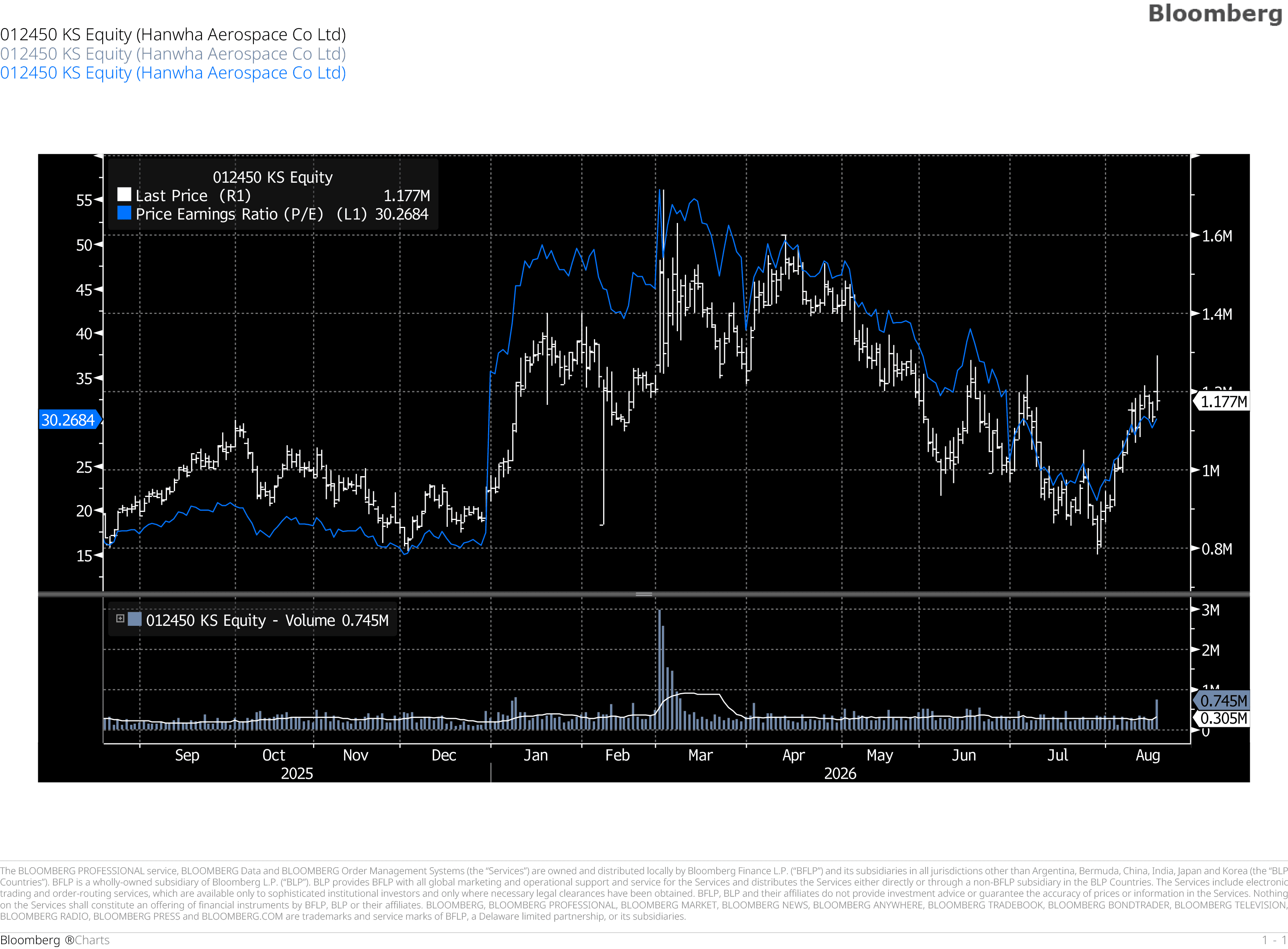
Hanwha Aerospace:
Valuation Reset: Hanwha Aerospace’s P/E has contracted meaningfully from its 2026 peak, bringing the stock to a more moderate valuation relative to earlier in the year.
Source: Bloomberg Finance
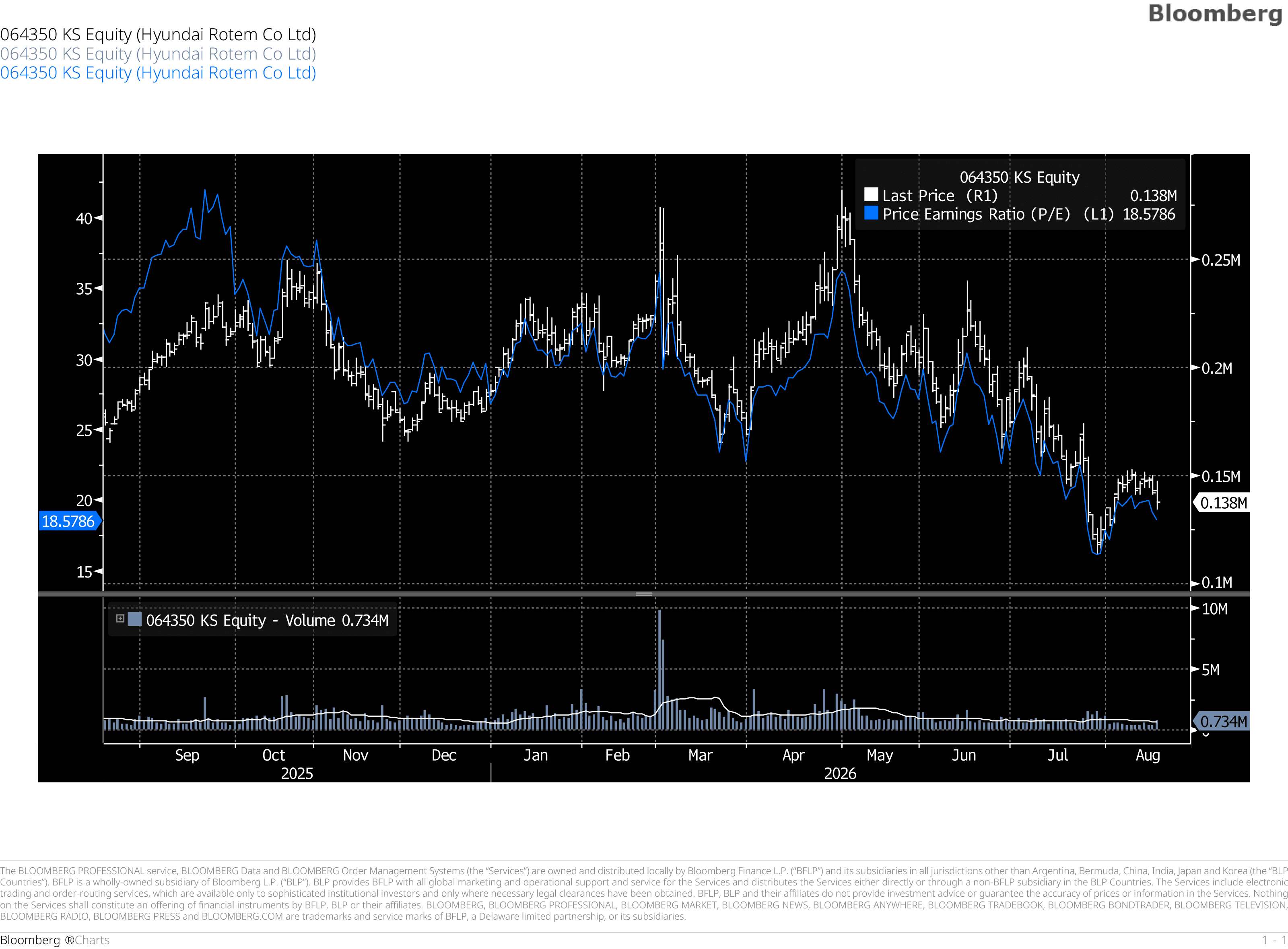
Hyundai Rotem:
Valuation Reset: Hyundai Rotem’s P/E has fallen substantially from its 12-month highs, creating a notably different valuation backdrop for investors evaluating the company today.
Source: Bloomberg Finance
Why Consider KDEF
KDEF seeks to offer investors a single-ticker way to access this theme through a concentrated, scored index of the leading Korean companies driving the country's defense innovation and export growth. Rather than requiring investors to time individual name selection through a volatile news cycle, be it geopolitical headlines, contract announcements, or currency swings, KDEF seeks to capture the sector's structural growth story.
For advisors evaluating thematic and geopolitical exposure within client portfolios, the current environment may offer a distinct entry point: a sector with a potential multi-year growth runway, a large and growing order book, and valuations that have reset from unsustainable extremes without the underlying demand story losing momentum.
With a PE in mid-August of around 15x compared to competing defense funds with a PE around 32x, the KDEF ETF may be considered a timely investment.15
The Takeaway
Markets rarely offer sectors with strong structural tailwinds and improved valuation discipline at the same time. Korea's defense industry, still early in its export expansion and still working through a substantial order backlog, may be presenting exactly that combination today. KDEF seeks to offer investors and advisors a way to participate in that story.
Sources:
1. BigGo Finance, "South Korea's Big 4 Defense Firms Post Approximately $754M Combined Q1 Operating Profit, Order Backlog Tops Approximately $68.4 Billion," May 10, 2026.
2. Defense.info, "South Korea's Defense Export Boom: From Middle Power to Global Pivotal State," June 22, 2025.
3. Malay Mail, "South Korea Pledges Bigger Defence Budget to Rival Global Powers, Eyes 4th Place in Arms Industry, Says President," October 20, 2025.
4. Seoul Economic Daily. "Korea Defense Stocks Fall 40% From Peak as Wars Drag On." July 20, 2026.
5. Hanwha Aerospace. "Hanwha Aerospace Secures Follow-On K9 Howitzer Contract with Finland." Press release. April 10, 2026.
6. Seoul Economic Daily. "Hanwha Aerospace to Produce, Sell K9 Howitzers in UAE." June 29, 2026.
7. Korea JoongAng Daily. "Could Korea's K9 Bid in Spain Influence Subsequent Deals with Poland, Romania?" August 7, 2026.
8. Defence Industry Europe. "Hyundai Rotem Signs $6.5 Billion Agreement with Poland for Second Batch of K2 Main Battle Tanks." August 1, 2025.
9. Korea Herald. "Hyundai Rotem Signs Deal to Build K2 Tanks in Poland." April 28, 2026.
10. KED Global. "Hyundai Rotem Nears $2 Bn Armored Vehicle Supply Deal with Peru." December 10, 2025.
11. Naval News. "LIG Signs First Export Deal for K-SAAM with Malaysia." April 22, 2026.
12. Korea Herald. "LIG Nex1 Clinches W3.7tr Deal to Export Missile Defense System to Iraq." September 20, 2024.
13. Seoul Economic Daily. "LIG D&A Jumps 9% as Global Demand for Korean Air Defense Grows." August 11, 2026.
14. Investing.com. "Hanwha Aerospace Co Ltd Stock Price Today | KS: 012450 Live." Accessed August 6, 2026.
15. Tickertape, "PLUS Korea Defense Industry Index ETF (KDEF) Price Live in India Today," accessed August 15, 2026
Investors should consider the investment objectives, risks, charges and expenses carefully before investing. For a prospectus or summary prospectus with this and other information about the Fund, please call 1-855-900-0030 or visit our website at www.plusetf.com. Read the prospectus or summary prospectus carefully before investing.
Holdings are subject to change. For current holdings go to www.plusetf.com.
The Fund is distributed by Foreside Fund Services, LLC and Exchange Traded Concepts, LLC serves as the investment advisor of the funds. Foreside Fund Services, LLC is not affiliated with Exchange Traded Concepts, LLC or any of its affiliates.
Risk Disclosures:
Investing involves risk, including possible loss of principal. There is no guarantee the Fund will achieve their stated objectives. In addition to the normal risks associated with investing, international investments may involve the risk of capital loss from unfavorable fluctuation in currency values, differences in generally accepted accounting principles or social, economic or political instability in other nations. Emerging markets involve heightened risks related to the same factors as well as increased volatility and lower trading volume. The Fund’s concentration in an industry or sector can increase the impact of, and potential losses associated with, the risks from investing in those industries/sectors.
The Fund’s concentration in a single country or a limited number of countries will increase the impact of, and potential losses associated with, the risks from investing in those countries.
The Fund is non-diversified. The Fund is new and has a limited operating history for investors to evaluate. A new and smaller fund may not attract sufficient assets to achieve investment and trading efficiencies. In addition to the normal risks associated with investing, investments in smaller companies typically exhibit higher volatility.
The Fund may invest in securities denominated in foreign currencies. Because the Fund's NAV is determined in U.S. dollars, the Fund's NAV could decline if currencies of the underlying securities depreciate against the U.S. dollar or if there are delays or limits on repatriation of such currencies. Currency exchange rates can be very volatile and can change quickly and unpredictably.
The Fund is a recently organized investment company with no operating history. As a result, prospective investors have no track record or history on which to base their investment decision. Moreover, investors will not be able to evaluate the Fund against one or more comparable funds on the basis of relative performance until the Funds has established a track record.
One basis point (bps) is equivalent to 0.01%.


