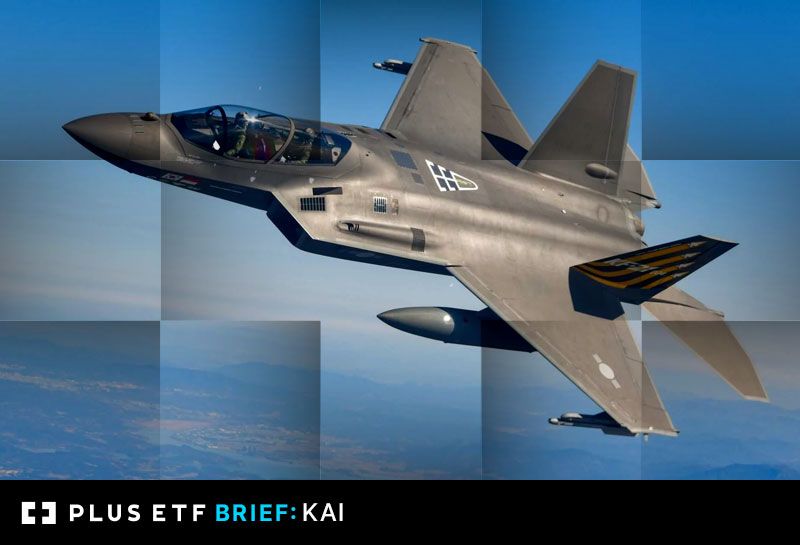
On the evening of October 2, 2026, Polish Defense Minister Władysław Kosiniak-Kamysz announced that the country’s 12 FA-50GF light fighters had entered combat duty, joining the quick-reaction alert force that guards Poland’s airspace and eastern border.1 They are the first of 48 FA-50 Fighting Eagles Poland ordered from Korea Aerospace Industries (KAI), and they reached that milestone about 37 months after the first two jets entered Polish service.2
For a company many Western investors could not have named five years ago, it is a good moment to look inside the hangar. KAI, headquartered in Sacheon on Korea’s southern coast, is the country’s primary builder of military aircraft. It is also one of the largest holdings in the PLUS Korea Defense Industry Index ETF (KDEF), alongside Hanwha Aerospace and Hyundai Rotem.3
KAI was formed when the aircraft divisions of Daewoo Heavy Industries, Samsung Aerospace and Hyundai Space and Aircraft were combined into a single national aircraft company.4 It trades on the Korea Exchange under the ticker 047810.
The product line is broad. On the fixed-wing side are the KT-1 Woongbi basic trainer, the T-50 Golden Eagle supersonic advanced trainer, the FA-50 light combat aircraft and now the KF-21. Rotary-wing work centers on the KUH-1 Surion utility helicopter. The company also builds unmanned aircraft, satellites, space launch vehicle hardware and flight simulators, and it provides maintenance, repair and overhaul services for military fleets.5 The less glamorous but steady side of the business is aerostructures, where KAI builds airframe components for Boeing and Airbus.5
Most of this comes together at a single complex in Sacheon, which houses the headquarters, design centers, final assembly lines for the KF-21, T-50/FA-50 and Surion, and the commercial plant handling Boeing 787 and Airbus A350 work.6 The Surion has started to travel too, landing its first export contract with Iraq in 2024, worth $94 million.6 In 2025, KAI reported revenue of about ₩3.70 trillion and operating income of ₩269.2 billion.4
Ten Months From Signature to Delivery
Poland’s purchase started with a problem. Warsaw had sent its Soviet-era MiG-29s to Ukraine and needed combat jets quickly.7 It signed a framework agreement for 48 FA-50s in July 2022 and executive contracts worth about $3 billion that September. KAI rolled out the first Polish jet roughly eight months later and began deliveries about ten months after signing, the fastest turnaround in the company’s history.8 All 12 gap-filler aircraft were handed over within about 15 months.9
Part of the trick was that the FA-50GF was essentially a Korean Air Force-configuration jet rerouted to an urgent customer.10 That reflects a broader Korean advantage. Because Seoul arms itself against an armed neighbor, its factories keep active production lines that can be redirected to export buyers. The same 2022 shopping trip saw Poland sign roughly $14 billion in contracts for Hyundai Rotem K2 tanks, Hanwha K9 howitzers and the KAI jets.11 In defense, a signed contract is a promise, and a delivered aircraft is proof. Governments that need hardware this decade, not next, notice who ships, and that is why delivery records drive the next order.
Delivery is not the whole story, though. Poland bought the gap fillers without a combat weapons package, then leased AIM-9P missiles from Korea and purchased 24 AIM-9L Sidewinders to give them a short-range air-to-air punch.12 The 36 FA-50PL jets that follow are the more serious machines, adding an AESA radar and aerial refueling.10 They were originally scheduled to start arriving in the second half of 2025, but Polish parliamentary information now points to 2026 through 2028.13
The Fighting Eagle’s Repeat Business
The FA-50 is the combat version of KAI’s T-50 supersonic trainer. It lists a top speed of about Mach 1.5 and a combat payload of up to 4.5 metric tons.13 It does not match a Lockheed Martin F-16 Block 70 or a Saab Gripen, but it costs far less to buy and operate.10 For many air forces, that tradeoff is the entire sales pitch.
Repeat orders offer a compelling endorsement. After a decade of operating the FA-50PH, the Philippines signed a roughly $700 million follow-on deal in June 2025.¹⁴ Malaysia ordered 18 upgraded Block 20 jets and is reportedly considering another purchase.¹⁶ ¹⁷ Across seven countries, firm orders for the T-50/FA-50 family total an estimated 290 aircraft.¹⁸ For prospective buyers, a customer returning after years of flying and maintaining an aircraft speaks louder than a sales pitch.
KAI subsequently reported improving order intake: first-quarter 2026 new orders rose 29.4% year over year to ₩309.3 billion, including ₩129.1 billion in export orders covering Philippine FA-50 logistics support, spare parts and other work.²⁶
For KDEF investors, renewed orders help explain how an aircraft program may generate business beyond its first delivery. Additional purchases extend production demand, while support contracts create opportunities across the fleet’s service life. Together, they may strengthen visibility into future revenue.
The Boramae Takes the Flight Line
If the FA-50 is KAI’s workhorse, the KF-21 Boramae is its statement piece. South Korea’s first domestically developed fighter, a twin-engine 4.5-generation jet, entered service with the Republic of Korea Air Force’s 156th Fighter Squadron on September 22, 2026.19 Six prototypes flew nearly 1,600 sorties over 42 months before development was declared complete in July.20
The weapons fit is serious. Block I carries four semi-recessed MBDA Meteor beyond-visual-range missiles, supplemented by IRIS-T short-range missiles and JDAM precision bombs, with a domestically developed Hanwha Systems APY-016K AESA radar in the nose.21 That radar is reported to detect targets at 150 to 200 kilometers and track about 20 at once, fused with a domestic electronic warfare suite and a Leonardo infrared search-and-track system.22 In August, Hyundai Rotem and KAI agreed to develop a long-range air-to-air missile for the jet.23
The roadmap runs in blocks: 40 Block I air-superiority jets by 2028 at roughly $83 million each, then 80 Block II aircraft at about $112 million each that add ground and maritime strike, with a future Block III adding an internal weapons bay.20 Export interest is building. Indonesia has been negotiating for 16 jets in a deal valued near ₩3 trillion (about $2.2 billion),24 and talks with the Philippines, the UAE and Malaysia were described as progressing.25
What KAI Brings To KDEF
KAI brings the aircraft dimension of Korea’s defense industry into KDEF’s portfolio, from an established light fighter with repeat export customers to a new generation of domestic fighter production. Its delivery record demonstrates execution, while repeat purchases and follow-on support contracts point to potential opportunities to extend customer relationships and sustain future production. For KDEF investors, improving order intake adds another dimension to the story: demand that can support future revenue as contracts move through manufacturing and delivery.
Alongside holdings involved in armored vehicles, propulsion, guided weapons, naval platforms and defense electronics, KAI illustrates the breadth of the PLUS Korea Defense Industry Index ETF (KDEF).
Curious what else fuels KDEF? Click here
Holding as of 11/1/26. Holdings subject to change, To view holdings, click here.
Sources:
Migflug. “Poland’s FA-50GF Fighters Enter Combat Duty After Three Unarmed Years.” Migflug Afterburner, October 4, 2026.
Jennings, Gareth. “Poland Declares FA-50 Light Fighter to Be Combat Ready.” Janes, October 5, 2026.
ETF Database. “KDEF: PLUS Korea Defense Industry Index ETF.” Analyst report. Data as of June 21, 2026. Robinhood. “PLUS Korea Defense Industry Index ETF (KDEF).” Holdings as of April 2, 2026. Accessed October 20, 2026.
Wikipedia. “Korea Aerospace Industries.” Accessed October 20, 2026.
GlobalData. “Korea Aerospace Industries Ltd – Company Profile.” Accessed October 20, 2026.
AviationOutlook. “Korea Aerospace Industries (KAI) – Company Analysis and Outlook Report 2026 (Updated).” AviationOutlook, 2026.
Osborne, Tony. “FA-50s Begin Polish Air Protection Duties.” Aerospace Daily & Defense Report, Aviation Week, October 5, 2026.
Aviacionline. “Poland Started to Receive Its KAI FA-50GF in Record Time.” Aviacionline, 2023.
Defence Security Asia. “KAI Delivers 12 FA-50GF (Gap Filler) to Poland, 15 Months After Contract Signing.” Defence Security Asia, n.d. Accessed October 20, 2026.
Royce, Douglas. “KAI Rolls Out First FA-50GF for Poland.” Defense & Security Monitor, Forecast International, June 7, 2023.
Asia Today. “Poland Deploys South Korean Weapons near NATO’s Eastern Flank.” Translated by UPI. UPI, October 5, 2026.
L., Wojciech. “Polish FA-50GF Fighting Eagles Enter Operational Duty.” Overt Defense, October 12, 2026.
Charter’97. “Poland Has Deployed an Unexpected Weapon to the Border with Ukraine.” Charter’97, October 4, 2026.
Nepomuceno, Priam. “PH, S. Korea Manufacturer Sign Deal for 12 More FA-50 Aircraft.” Philippine News Agency, June 4, 2025.
Philippine News Agency. “Delivery of New FA-50 Fighter Jets on Schedule – PAF.” June 26, 2026.
Free Malaysia Today. “Delivery of Fighter Jets from Korea on Schedule.” October 12, 2026.
The Economy. “Malaysia Considers Additional Purchases of South Korean FA-50 Fighter Jets.” January 28, 2026.
EurAsian Times. “When FA-50 Defeated LCA Tejas in Malaysia: How Service Record and U.S. Collaboration Tipped the 2023 Tender.” October 2026.
Wikipedia. “KAI KF-21 Boramae.” Accessed October 20, 2026.
19FortyFive. “Sorry, F-35: South Korea Flew 6 KF-21 Boramae Prototypes on Nearly 1,600 Sorties Over 42 Months and Declared Development Complete in July 2026.” 19FortyFive, September 2026.
Migflug. “South Korea Rolls Out First Mass-Production KF-21 Boramae Fighter Jet.” Migflug Afterburner, 2026.
Defence Security Asia. “The Boramae Gambit: How South Korea’s KF-21 Is Quietly Winning Over Southeast Asia.” Defence Security Asia, July 2026.
MT Newswires. “Hyundai Rotem, Korea Aerospace Team Up to Develop Long-Range Air-to-Air Missiles for KF-21.” MarketScreener, August 12, 2026.
Defence Security Asia. “South Korea’s KF-21 Fighter Export Surge Could Reshape Indo-Pacific Airpower as Philippines, Indonesia and UAE Eye 200-Jet Deals.” Defence Security Asia, July 2026.
Defence Security Asia. “KF-21 Fighter Aircraft Export Push Accelerates as Indonesia, UAE, Malaysia and Philippines Reshape Global Airpower Competition.” Defence Security Asia, June 2026.
Korea Aerospace Industries. 2026 Q1 Earnings Release. May 5, 2026.
Investors should consider the investment objectives, risks, charges and expenses carefully before investing. For a prospectus or summary prospectus with this and other information about the Fund, please call 1-855-900-0030 or visit our website at www.plusetf.com. Read the prospectus or summary prospectus carefully before investing.
Holdings are subject to change. For current holdings go to www.plusetf.com.
The Fund is distributed by Foreside Fund Services, LLC and Exchange Traded Concepts, LLC serves as the investment advisor of the funds. Foreside Fund Services, LLC is not affiliated with Exchange Traded Concepts, LLC or any of its affiliates.
Risk Disclosures:
Investing involves risk, including possible loss of principal. There is no guarantee the Fund will achieve their stated objectives. In addition to the normal risks associated with investing, international investments may involve the risk of capital loss from unfavorable fluctuation in currency values, differences in generally accepted accounting principles or social, economic or political instability in other nations. Emerging markets involve heightened risks related to the same factors as well as increased volatility and lower trading volume. The Fund’s concentration in an industry or sector can increase the impact of, and potential losses associated with, the risks from investing in those industries/sectors.
The Fund’s concentration in a single country or a limited number of countries will increase the impact of, and potential losses associated with, the risks from investing in those countries.
The Fund is non-diversified. The Fund is new and has a limited operating history for investors to evaluate. A new and smaller fund may not attract sufficient assets to achieve investment and trading efficiencies. In addition to the normal risks associated with investing, investments in smaller companies typically exhibit higher volatility.
The Fund may invest in securities denominated in foreign currencies. Because the Fund's NAV is determined in U.S. dollars, the Fund's NAV could decline if currencies of the underlying securities depreciate against the U.S. dollar or if there are delays or limits on repatriation of such currencies. Currency exchange rates can be very volatile and can change quickly and unpredictably.
The Fund is a recently organized investment company with no operating history. As a result, prospective investors have no track record or history on which to base their investment decision. Moreover, investors will not be able to evaluate the Fund against one or more comparable funds on the basis of relative performance until the Funds has established a track record.
One basis point (bps) is equivalent to 0.01%.


