Charting the Future of Maritime Power in KDEF
 Few companies embody South Korea’s rise in global shipbuilding and defense quite like Hanwha Ocean. Founded in 1973 near the Port of Okpo, the company began as a commercial shipbuilder and has grown into a global leader spanning oil tankers, LNG (Liquified Natural Gas) carriers, offshore plants, and advanced naval systems. [1] In 2023, Hanwha Ocean officially joined the Hanwha Group, aligning its industrial scale with a parent company rapidly investing across defense and clean energy. [2]
For investors tracking the PLUS Korea Defense Industry Index ETF (KDEF), Hanwha Ocean represents exposure to both traditional naval platforms and the innovations shaping the future of maritime defense. (as of 9/30/25)
From Tankers to Submarines
Hanwha Ocean first built its reputation in commercial shipbuilding with groundbreaking achievements - delivering the world’s first floating liquefied natural gas (LNG) facility in 2016 and, just four years later, the world’s largest container ship, a massive 23,000-TEU (twenty foot equivalent unit) vessel. [3] In 2025, the company reached another historic milestone with the delivery of its 200th LNG carrier, securing the No. 1 position in global market share. [4]
Hanwha Ocean’s extensive shipbuilding roots still matter. Its track record in Arctic-class LNG carriers, designed to withstand the brutal ice conditions of the Northern Sea Route, proves that the company can build for the toughest environments. [1] That know-how transfers directly to military platforms, where durability and reliability are non-negotiable.
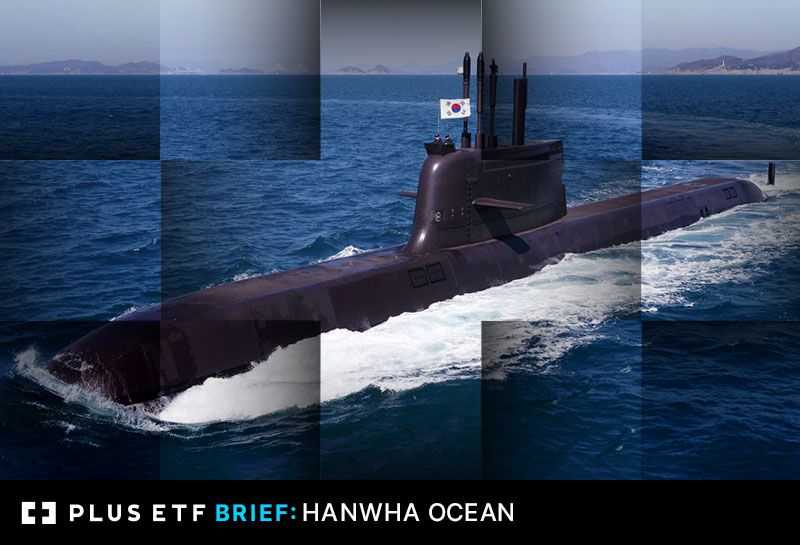
Their commercial shipbuilding knowledge and innovation has also translated into defense breakthroughs. In 2021, Hanwha Ocean became the first South Korean company to design and deliver a fully indigenous submarine, the KSS-III Dosan Ahn Chang-ho. [5] With export orders secured from Indonesia and interest from other navies, Hanwha Ocean is no longer just building for South Korea, it is competing globally. [6]
Surface combat ships have further enhanced Hanwha Ocean’s reputation. The company has delivered frigates to Bangladesh and Thailand, along with logistics support vessels to the United Kingdom and Norway, underscoring its capacity to meet the needs of a wide range of international customers. [5]
Expanding Beyond Korea
Hanwha Ocean’s ambitions extend far beyond Asia. In December 2024, the company partnered with Hanwha Systems to acquire Philly Shipyard in the United States, rebranded as Hanwha Philly Shipyard. [7] This move gives Hanwha Ocean a direct foothold in the U.S. naval ship market.
That expansion is already bearing fruit. In 2024, Hanwha Ocean won U.S. Navy maintenance and repair contracts, including for the USNS Wally Schirra and the USNS Yukon. [8][9] These agreements are significant: they mark the first time a Korean shipyard has serviced U.S. Navy vessels, opening a pathway for deeper defense collaboration.
For investors, this is a crucial detail: defense revenue is often steady, government-backed, and strategically sticky. The U.S. Navy’s decision to trust Hanwha Ocean with its assets speaks volumes about this shipbuilder.
Green Horizons
While defense anchors its strategy, Hanwha Ocean is also pioneering eco-friendly shipping solutions. Its LNG carriers already dominate the global market, and the company is pushing into new frontiers with ammonia, hydrogen, and CO₂ transport vessels. [10] Offshore wind power is another sector, Hanwha Ocean is building ultra-large wind turbine installation vessels (WTIVs), equipped with its smart ship platform HS4. [11]
Hanwha Ocean holds the No. 1 global position in operating very large crude oil carriers (VLCCs), with its fleet sailing across the world’s trade routes. These tankers aren’t just massive, they’re next-generation, eco-friendly vessels equipped with high-efficiency engines and advanced fuel-saving technologies designed to meet International Maritime Organization (IMO) environmental standards. [1]
Digital transformation is also part of their plan. Through automation, AI, and “smart yard” systems, Hanwha Ocean is streamlining shipbuilding while cutting emissions and improving worker safety. [2]
Why It Matters for KDEF
Hanwha Ocean’s addition in KDEF represents more than index mechanics - it’s an opportunity to track a company redefining its future. At the crossroads of proven commercial expertise and defense demand, Hanwha Ocean is reshaping its role in Korea’s industrial and defense landscape.
Through KDEF, investors gain diversified access to the nation’s defense ecosystem while retaining exposure to the strategic upside of Hanwha Ocean’s naval pivot.
At a time when maritime strategy has returned to the heart of global geopolitics, Hanwha Ocean is not simply building ships, it is seeking to build relevance. And within KDEF, that story is already embedded in the portfolio.
View KDEF holdings here.
Holdings subject to change.
Learn more about Hanwha Ocean here.
Sources:
[1] “Hanwha Ocean.” Hanwha. Accessed September 23, 2025. https://www.hanwha.com/companies/hanwha-ocean.do.
[2] “Forbes, Hanwha Ocean.” Forbes. Accessed September 23, 2025. https://www.forbes.com/companies/hanwha-ocean/.
[3] “Hanwha Ocean Achievements.” The Korea Times, February 17, 2025. https://www.koreatimes.co.kr/business/companies/20250217/hanwha-ocean-strengthens-presence-in-global-maritime-defense-sector.
[4] “Hanwha Ocean Delivers 200th LNG Carrier.” Asian Military Review, August 27, 2025. https://www.asianmilitaryreview.com/2025/08/hanwha-ocean-makes-inroads-into-north-america-foc/.
[5] Jae-huyuk Han, “Hanwha Ocean Strengthens Presence in Global Maritime Defense Sector.” The Korea Times, February 17, 2025.
[6] “South Korea’s Submarine Exports Expand with Indonesia Order.” Naval News, July 2021. https://www.navalnews.com/naval-news/2021/07/south-korea-indonesia-submarine-order/.
[7] “Hanwha to Acquire Philly Shipyard.” Philly Shipyard. June 20, 2024. https://www.phillyshipyard.com/hanwha-to-acquire-philly-shipyard/.
[8] “Hanwha Ocean Wins First U.S. Navy Maintenance Contract.” U.S. Naval Institute News, August 27, 2025. https://news.usni.org/2025/08/27/south-korean-shipbuilder-to-invest-5b-in-philadelphia-shipyard.
[9] “Hanwha Ocean Expands U.S. Navy Partnerships.” Business Insider, November 2024. https://www.businessinsider.com/hanwha-ocean-us-navy-maintenance-contract-2024.
[10] “Hanwha Ocean Develops Eco-Friendly LNG, Hydrogen and Ammonia Vessels.” MarineLink, October 28, 2020. https://www.marinelink.com/news/hanwha-ocean-develops-eco-friendly-vessels-486597.
[11] “Hanwha Ocean Secures Wind Turbine Installation Vessel Order.” Offshore Engineer, September 2022. https://www.oedigital.com/news/hanwha-ocean-wtiv-order-2022.
Investors should consider the investment objectives, risks, charges and expenses carefully before investing. For a prospectus or summary prospectus with this and other information about the Fund, please call 1-855-900-0030 or visit our website at www.plusetf.com. Read the prospectus or summary prospectus carefully before investing.
Holdings are subject to change. For current holdings go to www.plusetf.com.
The Fund is distributed by Foreside Fund Services, LLC and Exchange Traded Concepts, LLC serves as the investment advisor of the funds. Foreside Fund Services, LLC is not affiliated with Exchange Traded Concepts, LLC or any of its affiliates.
Risk Disclosures:
Investing involves risk, including possible loss of principal. There is no guarantee the Fund will achieve their stated objectives. In addition to the normal risks associated with investing, international investments may involve the risk of capital loss from unfavorable fluctuation in currency values, differences in generally accepted accounting principles or social, economic or political instability in other nations. Emerging markets involve heightened risks related to the same factors as well as increased volatility and lower trading volume. The Fund’s concentration in an industry or sector can increase the impact of, and potential losses associated with, the risks from investing in those industries/sectors.
The Fund’s concentration in a single country or a limited number of countries will increase the impact of, and potential losses associated with, the risks from investing in those countries.
The Fund is non-diversified. The Fund is new and has a limited operating history for investors to evaluate. A new and smaller fund may not attract sufficient assets to achieve investment and trading efficiencies. In addition to the normal risks associated with investing, investments in smaller companies typically exhibit higher volatility.
The Fund may invest in securities denominated in foreign currencies. Because the Fund's NAV is determined in U.S. dollars, the Fund's NAV could decline if currencies of the underlying securities depreciate against the U.S. dollar or if there are delays or limits on repatriation of such currencies. Currency exchange rates can be very volatile and can change quickly and unpredictably.
The Fund is a recently organized investment company with no operating history. As a result, prospective investors have no track record or history on which to base their investment decision. Moreover, investors will not be able to evaluate the Fund against one or more comparable funds on the basis of relative performance until the Funds has established a track record.
One basis point (bps) is equivalent to 0.01%.


