For more than two decades, South Korea has been exporting something more influential than products: cultural gravity.
 K-Pop groups like BTS and BLACKPINK fill stadiums from São Paulo to Singapore. K-dramas, like Squid Game, dominate global streaming platforms. [1] Hyundai is reshaping the EV landscape, while Samsung remains a force in global smartphones. [2] Even pop-culture–driven franchises like K-Pop Demon Hunter, which blends gaming, music, and stylized K-culture aesthetics, show how Korean creativity moves seamlessly across formats and borders, converting cultural excitement into commercial momentum.
Together, these industries have built a soft-power halo around Korea - one that is both magnetic and commercially powerful.
But Korea’s next global breakout isn’t entertainment, electronics, or autos.
It’s defense.
And the path that led Korea here may be uniquely compelling for investors.
Act I: The Cultural Flywheel That Redefined “Made in Korea”
South Korea’s global brand has shifted from niche to near-universal:
- K-Pop fandoms span 100+ countries. [3]
- Samsung led global smartphone shipments in Q1 2025 with 60.5 million units and 20% market share. [4]
- Hyundai and Kia combined now rank third worldwide in auto sales. [5]
This cultural and commercial ubiquity has done something remarkable: it has turned “Made in Korea” into shorthand for innovation, reliability, and speed. From Mexico City to Warsaw to Jakarta, Korean products don’t merely sell—they embed themselves in the mainstream.
Fueling this rise is an ecosystem optimized for acceleration: advanced semiconductor infrastructure, world-class engineers, elite software talent, and a national culture of rapid iteration. Today, that same innovation engine is reshaping an entirely different sector.
Act II: K-Defense: Korea’s Next Export Supercycle
South Korea has quietly become one of the most dynamic arms exporters in the world. In recent years, defense exports have climbed to $17.3 billion, according to government reports. [6]
Korean firms have secured some of the largest defense deals of the modern era. Poland finalized multi-billion-dollar contracts for K2 tanks and K9 howitzers, while Peru signed agreements tied to FA-50 fighter jet production. [7][8]
Why the surge? Korea builds military systems the same way it builds consumer technology:
- High performance
- Competitive pricing
- Fast delivery
- Customization for diverse global buyers
Nations long dependent on U.S. or European suppliers are diversifying and Seoul is increasingly a preferred partner. As Reuters reports, South Korea aims to become the world’s fourth-largest defense exporter, supported by substantial government backing. [9]
If K-Pop served as Korea’s cultural megaphone, K-Defense is rapidly becoming its geopolitical calling card.
Act III: The K-Wave Playbook Comes to Defense
The adoption curve mirrors patterns seen across Korea’s other global industries:
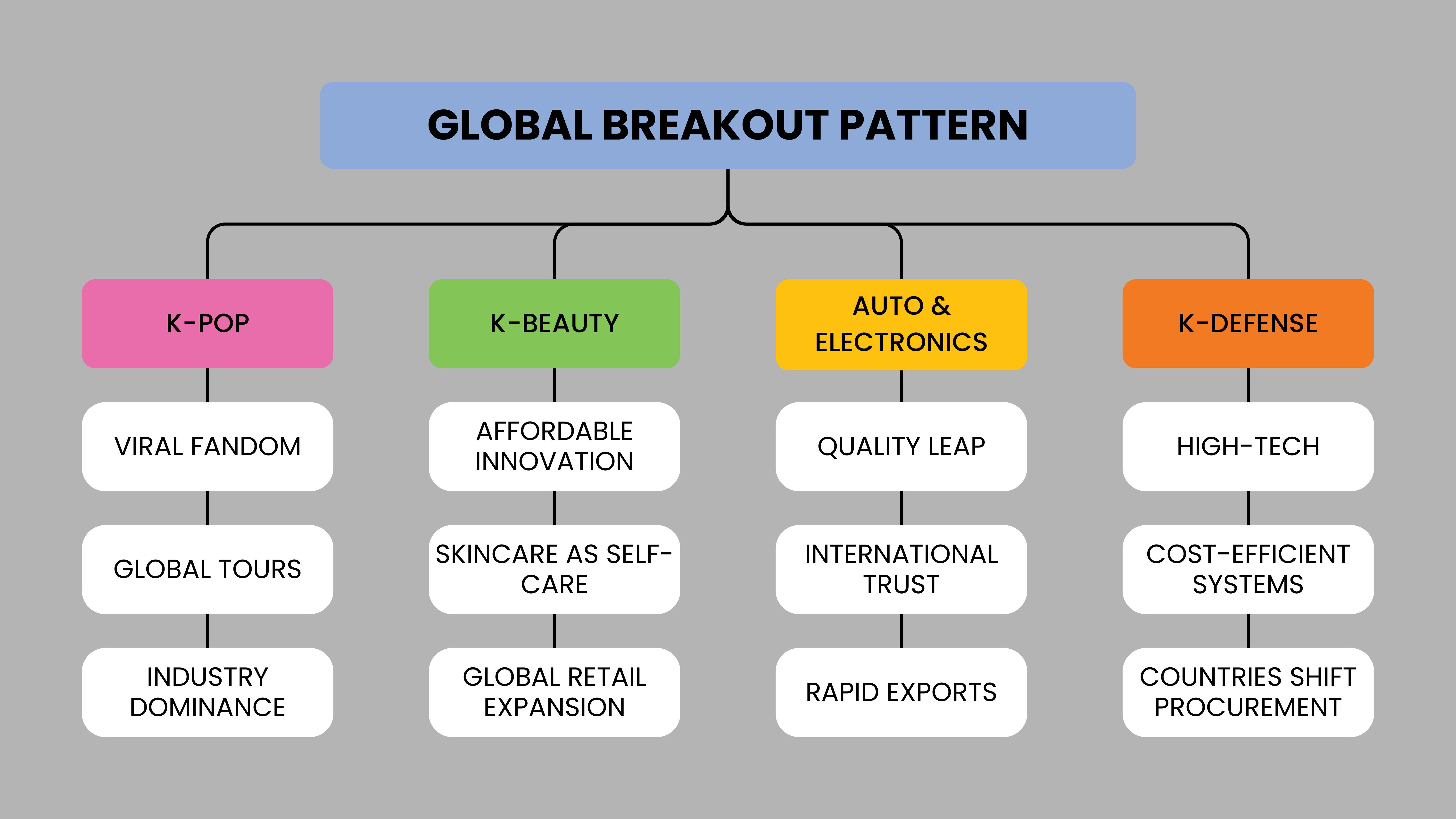
Chart: Visualization by the author
Korea’s competitive edge is structural: a national ecosystem built around speed, deep engineering talent, and improvement cycles measured in weeks, not years. Defense is simply the latest sector plugged into this relentless innovation model.
Act IV: KDEF: Access to Korea’s Next Global Inflection Point
For investors, the rise of K-Defense represents more than geopolitical momentum, it underscores a potential long-term thematic growth opportunity.
The Plus Korea Defense Industry Index ETF (KDEF) seeks to provide targeted exposure to companies powering this shift, including:
- Aerospace and advanced weapons platforms
- Cyber and AI-enabled defense technologies
- Military electronics and critical components
- Export-driven manufacturers at the core of the K-Defense boom
If the last two decades were defined by Korea’s cultural exports, the decade ahead may be shaped by its strategic defense exports. KDEF seeks to position investors at the intersection where culture meets markets and where Korea’s next global growth curve is emerging.
From K-Pop to K-Defense, Korea’s evolution into a global defense leader isn’t just notable.
It’s investable.
Explore KDEF’s Holdings here. >> Holding Subject to change.
[1] Ramachandran, Naman, “Squid Game 2” Leads Korean Dominance on Netflix Global Charts, Ampere Report Reveals, Variety, 4/14/25.
[2] ETech Desk, Samsung leads as global smartphone shipments rise 2%, The Economic Times, 7/22/25.
[3] Culture Reporter, No. of K-Pop on demand streams grows 42% led by Japan, Korea.net, 10/26/2023
[4] Sher, Demi, Samsung: Empowering Athletes with Mobile Innovations, Investing.com, 10/31/25.
[5] Jin, Hyunjoo, Hyundai Motor, Kia Motor see uptick in 2025 sales after missing 2024 targets, Reuters, 1/3/25.
[6] Korea.net – Korean arms exports reaching $17.3B: https://www.korea.net/NewsFocus/Business/view?articleId=278648
[7] Reuters, South Korea signs deal to supply tanks, armored vehicles to Peru, Reuters, 12/9/25.
[8] Han-kook, Jung et al, Korea’s $6.7B tank deal signals shift to global defense partnerships, The ChoSun Daily, 7/3/25.
[9] Lee, Joyce, South Korea to become 4th-largest global defense power, President Lee says, Reuters, 10/20/25.
Investors should consider the investment objectives, risks, charges and expenses carefully before investing. For a prospectus or summary prospectus with this and other information about the Fund, please call 1-855-900-0030 or visit our website at www.plusetf.com. Read the prospectus or summary prospectus carefully before investing.
Holdings are subject to change. For current holdings go to www.plusetf.com.
The Fund is distributed by Foreside Fund Services, LLC and Exchange Traded Concepts, LLC serves as the investment advisor of the funds. Foreside Fund Services, LLC is not affiliated with Exchange Traded Concepts, LLC or any of its affiliates.
Risk Disclosures:
Investing involves risk, including possible loss of principal. There is no guarantee the Fund will achieve their stated objectives. In addition to the normal risks associated with investing, international investments may involve the risk of capital loss from unfavorable fluctuation in currency values, differences in generally accepted accounting principles or social, economic or political instability in other nations. Emerging markets involve heightened risks related to the same factors as well as increased volatility and lower trading volume. The Fund’s concentration in an industry or sector can increase the impact of, and potential losses associated with, the risks from investing in those industries/sectors.
The Fund’s concentration in a single country or a limited number of countries will increase the impact of, and potential losses associated with, the risks from investing in those countries.
The Fund is non-diversified. The Fund is new and has a limited operating history for investors to evaluate. A new and smaller fund may not attract sufficient assets to achieve investment and trading efficiencies. In addition to the normal risks associated with investing, investments in smaller companies typically exhibit higher volatility.
The Fund may invest in securities denominated in foreign currencies. Because the Fund's NAV is determined in U.S. dollars, the Fund's NAV could decline if currencies of the underlying securities depreciate against the U.S. dollar or if there are delays or limits on repatriation of such currencies. Currency exchange rates can be very volatile and can change quickly and unpredictably.
The Fund is a recently organized investment company with no operating history. As a result, prospective investors have no track record or history on which to base their investment decision. Moreover, investors will not be able to evaluate the Fund against one or more comparable funds on the basis of relative performance until the Funds has established a track record.
One basis point (bps) is equivalent to 0.01%.


