KDEF is a gateway to K-Defense, built in Korea, built for what’s next.
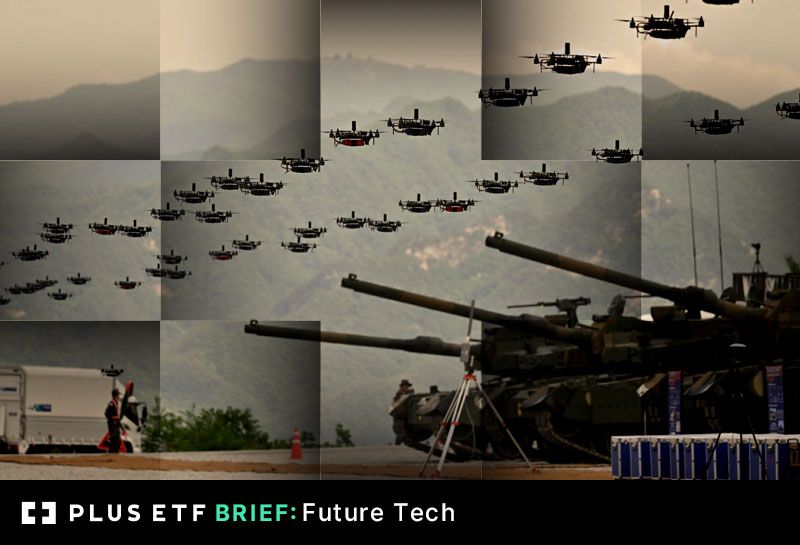 For investors seeking targeted exposure to one of the world’s fastest-scaling defense ecosystems, the PLUS Korea Defense Industry Index ETF (KDEF) aims to deliver direct access to the companies shaping South Korea’s emerging “K-Defense” export engine. This is a sector no longer defined by legacy hardware, it's now a vertically integrated technology platform spanning robotics, semiconductors, cyber, naval systems, and dual-use innovation.
1. Autonomy as a structural growth driver
KDEF’s core holdings (as of 12/04/25), Hanwha Aerospace, LIG Nex1, Hanwha Systems, and Korea Aerospace Industries*, sit at the center of a global shift toward autonomous warfare technologies. Think automated artillery, AI-guided loitering drones, and autonomous targeting systems designed to shrink decision time from minutes to seconds. Korea’s Defense Innovation 4.0 strategy accelerates government-backed investment in AI-enabled artillery, loitering munitions, autonomous UAVs, and battlefield decision-support systems. [1]
For advisors, autonomy represents a multi-cycle growth theme: rising global demand, export-friendly platforms, and mission-critical modernization across NATO, the Indo-Pacific, and emerging markets. Korean companies are aggressively taking global market share thanks to speed, cost competitiveness, and software-first development.
2. Naval defense: a durable export pipeline
KDEF’s exposure to Hanwha Ocean and HJ Shipbuilding & Construction ties investors to a shipbuilding sector undergoing a major digital upgrade. Smart yards using robotics, AI planning engines, and integrated supply chains are boosting output and enabling Korea to compete in advanced warships, submarines, and unmanned surface vessels.
For investors, naval defense is a long-duration capex category** with high switching costs and multi-year order books. Korea’s shipbuilders are increasingly winning contracts from Europe, the Middle East, and Southeast Asia, giving KDEF embedded exposure to a global naval modernization cycle. [2]
3. Dual-use tech: the multiplier effect
Unlike traditional defense ETFs, KDEF may benefit from Korea’s dual-use ecosystem, where commercial tech rapidly transitions to military application.
Key enablers include:
- Semiconductors powering sensors, missile seekers, AI processing units, and secure communications
- Robotics & automation flowing from industrial manufacturing into unmanned ground and air systems
- Advanced materials used across aerospace, armor, and high-end propulsion
- Logistics tech that compresses production timelines and strengthens readiness
For advisors, this dual-use pipeline functions as a potential growth accelerator, bringing civilian R&D efficiency into defense timelines, one of Korea’s most compelling competitive advantages.
4. Cyber, C4I,*** and digital defense infrastructure
Cyber-defense is now a mandatory component of military spending, and KDEF includes companies like Hanwha Systems that build secure command networks, integrated radar systems, electronic warfare tools, and cyber-resilience platforms that detect and counter intrusions in real time. As warfare shifts toward data, jamming, and electronic attack, these capabilities matter as much as ships and missiles.
These capabilities align with global priorities: defense forces everywhere are shifting funding toward data protection, secure communications, and threat intelligence. For ETF allocators, this may add a non-cyclical, software-oriented revenue stream to the portfolio.
Portfolio case for KDEF
KDEF seeks to provide advisors and investors with:
- Pure-play exposure to a rapidly globalizing defense export nation
- Potential growth themes: autonomy, naval modernization, cyber, and dual-use tech
- Structural tailwinds from geopolitical realignment in Europe and Asia
- Defense Diversification versus U.S.- and EU-centric defense ETFs
- Access to upstream value chains, from chips to shipyards to command systems
For clients seeking a forward-looking defense allocation, KDEF seeks to offer a tech-driven way to participate in the future of warfare innovation. For investors, there’s also an additional perspective in accessing Korea’s defense sector through an ETF built by a Korean firm, one that has its pulse on the domestic industry and the geopolitical environment and understands the ecosystem from the inside out.
*To explore KDEF Holdings see www.plusetf.com for a full list of positions. Holdings Subject To Change
Hanwha Ocean, HJ Shipbuilding & Construction, Hanwha Systems, Hanwha Aerospace, LIG Nex1, Korea Aerospace Industries make 2.71%, 3.47%, 3.93%, 15.32%, 4.84%, 7.95% respectively of KDEF as of 12/04/25.
** A long-duration capex category is a segment of the market where customers (usually governments) spend large amounts of money on assets that take years to design, build, and deliver.
***C4I: stands for Command, Control, Communications, Computers and Intelligence, it refers to the integrated systems militaries use to plan, direct, coordinate, and monitor operations.
[1] Sharma, Abhishek, Mapping South Korea’s Defense Industrialization in the Age of Smart Technologies, ORFonline.org, 10/15/25.
[2] Lee, Joyce, South Korea’s Hanwha Ocean targets US Navy orders as Trump seeks shipbuilding ties, Reuters, 5/5/25.
Investors should consider the investment objectives, risks, charges and expenses carefully before investing. For a prospectus or summary prospectus with this and other information about the Fund, please call 1-855-900-0030 or visit our website at www.plusetf.com. Read the prospectus or summary prospectus carefully before investing.
Holdings are subject to change. For current holdings go to www.plusetf.com.
The Fund is distributed by Foreside Fund Services, LLC and Exchange Traded Concepts, LLC serves as the investment advisor of the funds. Foreside Fund Services, LLC is not affiliated with Exchange Traded Concepts, LLC or any of its affiliates.
Risk Disclosures:
Investing involves risk, including possible loss of principal. There is no guarantee the Fund will achieve their stated objectives. In addition to the normal risks associated with investing, international investments may involve the risk of capital loss from unfavorable fluctuation in currency values, differences in generally accepted accounting principles or social, economic or political instability in other nations. Emerging markets involve heightened risks related to the same factors as well as increased volatility and lower trading volume. The Fund’s concentration in an industry or sector can increase the impact of, and potential losses associated with, the risks from investing in those industries/sectors.
The Fund’s concentration in a single country or a limited number of countries will increase the impact of, and potential losses associated with, the risks from investing in those countries.
The Fund is non-diversified. The Fund is new and has a limited operating history for investors to evaluate. A new and smaller fund may not attract sufficient assets to achieve investment and trading efficiencies. In addition to the normal risks associated with investing, investments in smaller companies typically exhibit higher volatility.
The Fund may invest in securities denominated in foreign currencies. Because the Fund's NAV is determined in U.S. dollars, the Fund's NAV could decline if currencies of the underlying securities depreciate against the U.S. dollar or if there are delays or limits on repatriation of such currencies. Currency exchange rates can be very volatile and can change quickly and unpredictably.
The Fund is a recently organized investment company with no operating history. As a result, prospective investors have no track record or history on which to base their investment decision. Moreover, investors will not be able to evaluate the Fund against one or more comparable funds on the basis of relative performance until the Funds has established a track record.
One basis point (bps) is equivalent to 0.01%.


