For decades, South Korea's economic identity has rested on a simple fact: it makes things, and it makes them exceptionally well. Manufacturing still drives the country's economy today, accounting for 24.3% of GDP, 90% of exports, and more than 80% of national R&D spending, according to the U.S. International Trade Administration.1 What's changing is how that manufacturing gets done. Korea is now pointing its industrial engine at itself, using artificial intelligence to automate the factories that already make it a global manufacturing leader.
Korea is not only manufacturing many of the technologies powering the AI era; it is also using AI to modernize the way those technologies are built. As the country works towards more AI manufacturing zones, Korea may be positioning itself as a model for how advanced economies can modernize industrial capacity.
From smart factories to autonomous ones
Korea's smart factory push isn't new. But it has entered a new phase. In September 2024, the Korean government introduced financing of up to $7.5 billion for an AI Autonomous Manufacturing Project, aimed at deploying AI-based automation across every manufacturing sector, partly to offset the country's shrinking working-age population, per trade officials cited by MarketScale2. The country's smart factory count has climbed to roughly 30,000, and the government's stated goal is more than 100 AI-based manufacturing zones by 2030, concentrated on AI, robotics, and next-generation vehicles.1,2
In June 2026, the government went further, unveiling a "Manufacturing AI 2030" strategy that calls for roughly 20 trillion won (about $14 billion) in manufacturing AI-transformation investment, with a target of generating 100 trillion won in added value.3 The plan includes a dedicated manufacturing-AI data library and specialized foundation models, and it explicitly leans on cooperation between large conglomerates and the small and mid-sized enterprises that make up more than 99% of Korean companies.
What autonomous manufacturing looks like on the floor
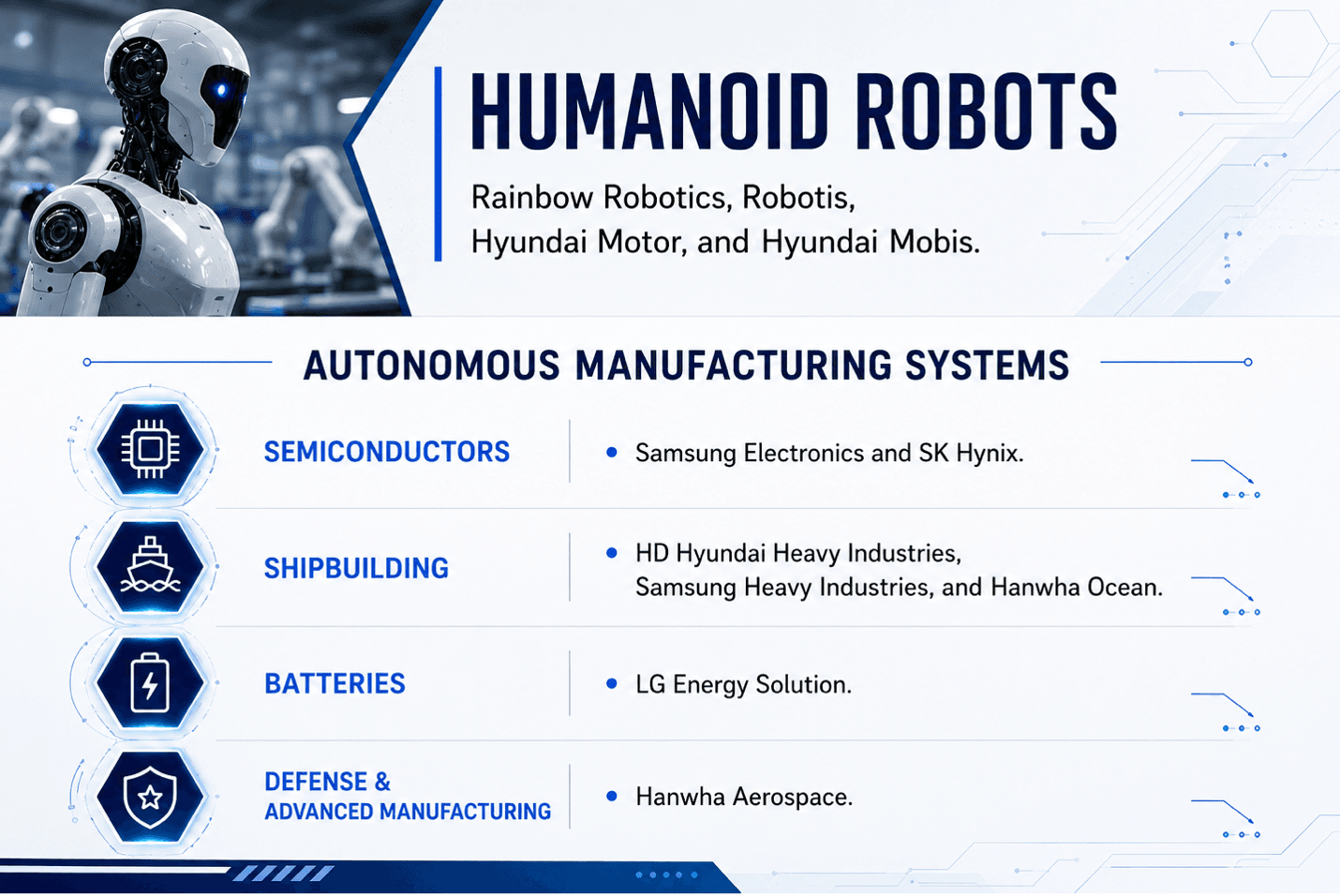
This is where the thesis becomes concrete rather than conceptual. Autonomous manufacturing requires machines that can act (robotics), eyes that can see and judge quality in real time (machine vision), and the chips and sensors that process it all instantly. The Plus Korea Manufacturing Core Alliance Index ETF’s (KMCA) holdings aim to sit across each layer of that stack: (all holdings as of 8/26/26)
Humanoid Robots
Rainbow Robotics, a KAIST*-founded robotics maker now backed by Samsung Electronics, produces the core components inside collaborative robots, including drivers, controllers, brakes, and encoders, along with humanoid robot platforms.
ROBOTIS makes the actuators, gear reducers, and control systems that give robots precise, repeatable movement, along with its own autonomous indoor and outdoor delivery robots. Components like these are the connective tissue between a factory's software and its physical machines.
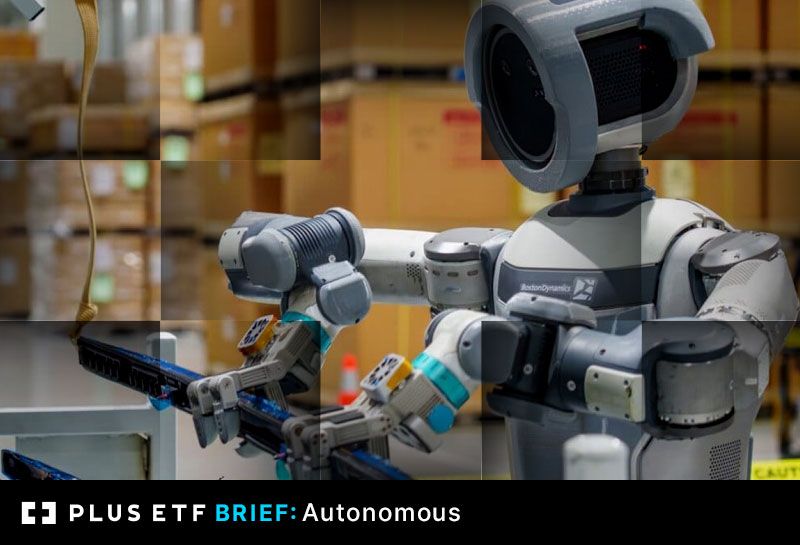
Hyundai Motor, better known for cars, is one of the more direct plays on factory-floor autonomy in the portfolio. In July 2026, Hyundai moved to take full ownership of Boston Dynamics by buying out SoftBank's remaining stake, deepening its push into "Physical AI." The company plans to deploy Boston Dynamics' Atlas humanoid robot inside its own manufacturing plants, starting with parts-sequencing work in 2028 and expanding into component assembly by 2030, with production capacity targeted at up to 30,000 units a year.5
Hyundai Mobis, the group's auto parts arm, has developed its own mobile collaborative robots and autonomous logistics robots for factory and office settings, along with wearable exoskeletons that support workers on overhead and physically demanding tasks, showing the robotics push extends well beyond Hyundai's marquee humanoid bet.
Autonomous Manufacturing Systems
Semiconductors
Samsung Electronics, KMCA's largest single holding, announced in February 2026 that it would convert its global manufacturing footprint into "AI-Driven Factories" by 2030, layering digital twin simulations and dedicated AI agents across quality control, production, and logistics. The company is also phasing in humanoid and task-specialized robots, including logistics and assembly units, across its production lines.6
SK Hynix is targeting a fully "autonomous fab" by 2030, one that learns and makes decisions on its own to shorten the path from chip design to mass production. The effort leans on a partnership with NVIDIA to build fab-wide digital twins and already includes AI models that outperform existing systems at catching wafer defects and predicting new materials.7
Defense & Advanced Manufacturing
Hanwha Aerospace is carrying automation beyond its own factory floor, forming a $1.5 billion physical-AI joint venture with gaming company Krafton that pairs Hanwha's defense and manufacturing infrastructure with Krafton's simulation technology, alongside its own work integrating AI into unmanned ground vehicles used across its production lines.8
Shipbuilding
HD Hyundai Heavy Industries, Samsung Heavy Industries, and Hanwha Ocean, Korea's three largest shipbuilders, are racing to automate one of manufacturing's hardest environments to robotize. HD Hyundai's AI-powered welding robots have lifted shipyard output from roughly 500 to 750 tons a day, while Samsung Heavy Industries has partnered directly with Rainbow Robotics to co-develop AI-equipped welding robots that can operate autonomously inside ship blocks and on inclined surfaces. Hanwha Ocean has deployed dozens of collaborative robots at its Geoje yard. Together they illustrate how the same robotics technology is spreading from electronics assembly lines into heavy industry.
Batteries
LG Energy Solution built a next-generation cylindrical battery smart factory around intelligent, autonomous manufacturing, using digital twin technology to model production of its 46-series batteries before changes are ever made on the physical line, a project that won LG Group's top internal innovation award in 2026.9
Taken together, these holdings show a single policy theme running through nearly every pillar the KMCA index tracks: AI semiconductors, batteries, robotics, shipbuilding, defense, and power infrastructure. It isn't just the household names bolting robots onto assembly lines; it's the chipmakers building fabs that learn on their own, the component suppliers automating precision production, and the battery and defense manufacturers running the same digital twin playbook, all pointed at the same goal.
KMCA Holdings as of 8/26/26. Holdings subject to change. Click here, to view holdings.
Why this may matter for the investment case
The conventional Korea narrative, chips and ships, undersells what's happening. Government spending, corporate capital, and export data all point to the same conclusion: Korea isn't just supplying the picks and shovels for the global AI buildout, it's using AI to defend and extend the industrial base that makes it a supplier in the first place. Hyundai Motor Group's separate $6.3 billion commitment to build an AI, robotics, and hydrogen hub in Saemangeum, part of a larger 125.2 trillion won domestic investment plan through 20304, is a sign that private capital is moving in the same direction as public policy.
For investors, we believe that alignment, government financing, corporate capex, and technology suppliers all pulling toward the same outcome, is what separates a durable structural theme from a short-lived one.
Holdings subject to change. To view holdings click here.>>
*Korea Advanced Institute of Science and Technology (KAIST): a top science and engineering research university located in Daejeon, South Korea.
Sources:
1. International Trade Administration. "South Korea - Manufacturing Technology - Smart Factory." U.S. Department of Commerce, June 29, 2026.
2. MarketScale Newsroom. "South Korea Commits $7.5 Billion to AI-Autonomous Manufacturing as Smart Factory Count Hits 30,000." MarketScale, July 11, 2026.
3. Businesskorea. "South Korea Pledges Trillion-Won Manufacturing AI Push." June 30, 2026.
4. KED Global. "Hyundai to Build $6.3 Billion AI, Robotics, Hydrogen Hub in South Korea." KED Global, February 27, 2026.
5. Silicon Republic. "Hyundai to Take Full Ownership of Boston Dynamics." Silicon Republic, July 2026
6. Samsung Newsroom. "Samsung Electronics Announces Strategy To Transition Global Manufacturing Into 'AI-Driven Factories' by 2030." Samsung Newsroom, February 28, 2026.
7. Seoul Economic Daily. "SK Hynix to Build Self-Learning 'Autonomous Fab' by 2030." Seoul Economic Daily, March 18, 2026.
8. The Korea Times. "Hanwha Aerospace Partners With Gaming Giant Krafton To Develop Physical AI." The Korea Times, March 13, 2026.
9. The Korea Times. "LG Energy Solution Leads Battery Industry's Shift To AI-Driven Manufacturing." The Korea Times, May 25, 2026.
Investors should consider the investment objectives, risks, charges and expenses carefully before investing. For a prospectus or summary prospectus with this and other information about the Fund, please call 1-855-900-0030 or visit our website at www.plusetf.com. Read the prospectus or summary prospectus carefully before investing.
Holdings are subject to change. For current holdings go to www.plusetf.com.
The Fund is distributed by Foreside Fund Services, LLC and Exchange Traded Concepts, LLC serves as the investment advisor of the funds. Foreside Fund Services, LLC is not affiliated with Exchange Traded Concepts, LLC or any of its affiliates.
Risk Disclosures:
Investing involves risk, including possible loss of principal. There is no guarantee the Fund will achieve their stated objectives. In addition to the normal risks associated with investing, international investments may involve the risk of capital loss from unfavorable fluctuation in currency values, differences in generally accepted accounting principles or social, economic or political instability in other nations. Emerging markets involve heightened risks related to the same factors as well as increased volatility and lower trading volume. The Fund’s concentration in an industry or sector can increase the impact of, and potential losses associated with, the risks from investing in those industries/sectors.
The Fund’s concentration in a single country or a limited number of countries will increase the impact of, and potential losses associated with, the risks from investing in those countries.
The Fund is non-diversified. The Fund is new and has a limited operating history for investors to evaluate. A new and smaller fund may not attract sufficient assets to achieve investment and trading efficiencies. In addition to the normal risks associated with investing, investments in smaller companies typically exhibit higher volatility.
The Fund may invest in securities denominated in foreign currencies. Because the Fund's NAV is determined in U.S. dollars, the Fund's NAV could decline if currencies of the underlying securities depreciate against the U.S. dollar or if there are delays or limits on repatriation of such currencies. Currency exchange rates can be very volatile and can change quickly and unpredictably.
The Fund is a recently organized investment company with no operating history. As a result, prospective investors have no track record or history on which to base their investment decision. Moreover, investors will not be able to evaluate the Fund against one or more comparable funds on the basis of relative performance until the Funds has established a track record.
One basis point (bps) is equivalent to 0.01%.


