For U.S. financial advisors, global diversification isn’t just about spreading risk - it’s about finding new opportunities. And one market that is rapidly stepping onto the world stage deserves a closer look: South Korea’s defense industry.
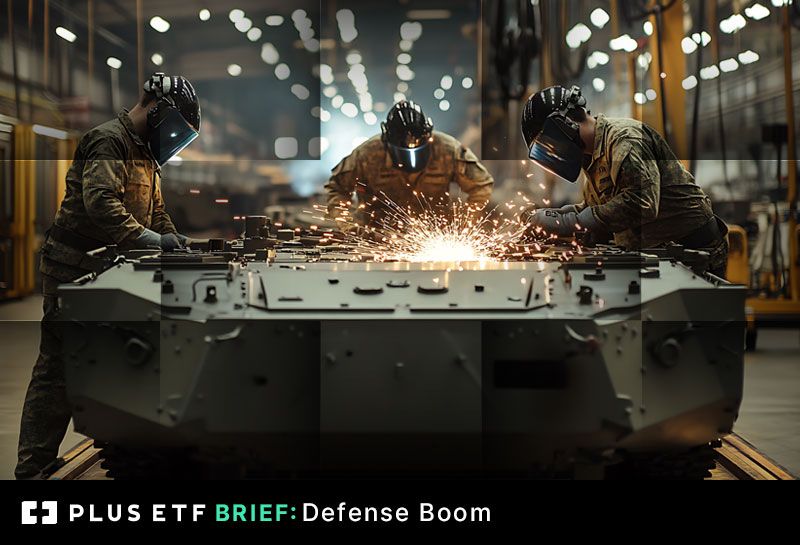 You might know South Korea for its K-pop, smartphones, or electric vehicles. But defense? That is an interesting and timely sector advisors shouldn’t overlook.
According to the Stockholm International Peace Research Institute, South Korea recently entered the ranks of the world’s top 10 defense exporters. [1] And it’s not just selling to its closest neighbors. Korean defense firms are landing contracts across Europe, Asia, and the Middle East — positioning themselves as a rising force in the global military supply chain.
So why is Korea’s defense sector gaining ground? And how can U.S. investors gain access?
That’s where the Plus Korea Defense Industry Index ETF (KDEF) comes in.
The Strategic Why: Korea’s Expanding Global Footprint
While headlines often focus on North Korea’s saber-rattling, South Korea has quietly been building something much larger: a defense industrial base that can hold its own against long-established global players. From next-generation tanks and artillery systems to advanced fighter jets and missile defense technology, Korean firms now offer products competitive with U.S. and European counterparts — often at more affordable price points.
In recent years, Korean defense manufacturers have secured major deals with NATO-aligned countries. One high-profile example: Poland’s multi-billion-dollar contract for Korean K2 tanks and K9 self-propelled howitzers. [2] Deals like this signal a shift: allies are broadening their supply chains beyond the U.S. and traditional European defense firms.
Beyond Traditional Defense ETFs
Here’s the catch for U.S. investors: most traditional aerospace and defense ETFs remain heavily concentrated in U.S. and Western European companies. While those names still matter, they may not fully capture the emerging engine Korea represents.
KDEF was built with that gap in mind. By tracking the Plus Korea Defense Industry Index, KDEF provides targeted exposure to Korea’s defense sector specifically — not as a side allocation, but as the main event.
That means investors may gain access to companies developing cutting-edge military tech: think unmanned systems, missile defense platforms, and next-gen armored vehicles.
Why Advisors Should Pay Attention Now
For financial advisors looking to add global defense exposure beyond the usual suspects, Korea’s story may offer three clear advantages:
- Advanced Manufacturing Edge: South Korea’s expertise in electronics, robotics, and manufacturing gives its defense firms a tech-forward edge.
- Global Demand Tailwinds: With increasing geopolitical tensions worldwide, demand for military hardware isn’t likely to slow anytime soon.
- Strategic Alliances: Korea’s partnerships with NATO countries and its alignment with U.S. strategic interests make it a less speculative play compared to emerging-market defense industries.
Bottom Line: Don’t Miss Potential Opportunity Beyond the Demilitarized Zone
South Korea’s defense sector isn’t just about regional security — it’s a global player with rising influence. For advisors looking to help clients diversify international equity allocations in sectors poised for long-term demand, KDEF may provide a direct, focused solution.
Explore how KDEF can offer your portfolios access to this defense powerhouse.
Ready. Aim. Allocate: Explore KDEF
[1] Ji-Eun, Seo, Ukraine ranks top arms buyer, South Korea slips into top 10 sellers, Korea JoongAng Daily, 3/10/25.
[2] Ratka, Damien, Polish-Korean Consortium Created, Defense 24, 4/3/23.
Investors should consider the investment objectives, risks, charges and expenses carefully before investing. For a prospectus or summary prospectus with this and other information about the Fund, please call 1-855-900-0030 or visit our website at www.plusetf.com. Read the prospectus or summary prospectus carefully before investing.
Holdings are subject to change. For current holdings go to www.plusetf.com.
The Fund is distributed by Foreside Fund Services, LLC and Exchange Traded Concepts, LLC serves as the investment advisor of the funds. Foreside Fund Services, LLC is not affiliated with Exchange Traded Concepts, LLC or any of its affiliates.
Risk Disclosures:
Investing involves risk, including possible loss of principal. There is no guarantee the Fund will achieve their stated objectives. In addition to the normal risks associated with investing, international investments may involve the risk of capital loss from unfavorable fluctuation in currency values, differences in generally accepted accounting principles or social, economic or political instability in other nations. Emerging markets involve heightened risks related to the same factors as well as increased volatility and lower trading volume. The Fund’s concentration in an industry or sector can increase the impact of, and potential losses associated with, the risks from investing in those industries/sectors.
The Fund’s concentration in a single country or a limited number of countries will increase the impact of, and potential losses associated with, the risks from investing in those countries.
The Fund is non-diversified. The Fund is new and has a limited operating history for investors to evaluate. A new and smaller fund may not attract sufficient assets to achieve investment and trading efficiencies. In addition to the normal risks associated with investing, investments in smaller companies typically exhibit higher volatility.
The Fund may invest in securities denominated in foreign currencies. Because the Fund's NAV is determined in U.S. dollars, the Fund's NAV could decline if currencies of the underlying securities depreciate against the U.S. dollar or if there are delays or limits on repatriation of such currencies. Currency exchange rates can be very volatile and can change quickly and unpredictably.
The Fund is a recently organized investment company with no operating history. As a result, prospective investors have no track record or history on which to base their investment decision. Moreover, investors will not be able to evaluate the Fund against one or more comparable funds on the basis of relative performance until the Funds has established a track record.
One basis point (bps) is equivalent to 0.01%.


