The Bank of Korea’s decision in August to raise its benchmark interest rate by another 25 basis points to 3.00% is more than a monetary-policy event. It comes at a time when Korea’s economic fundamentals are showing renewed strength, giving the central bank room to tighten policy even as the U.S. Federal Reserve remains on hold.1
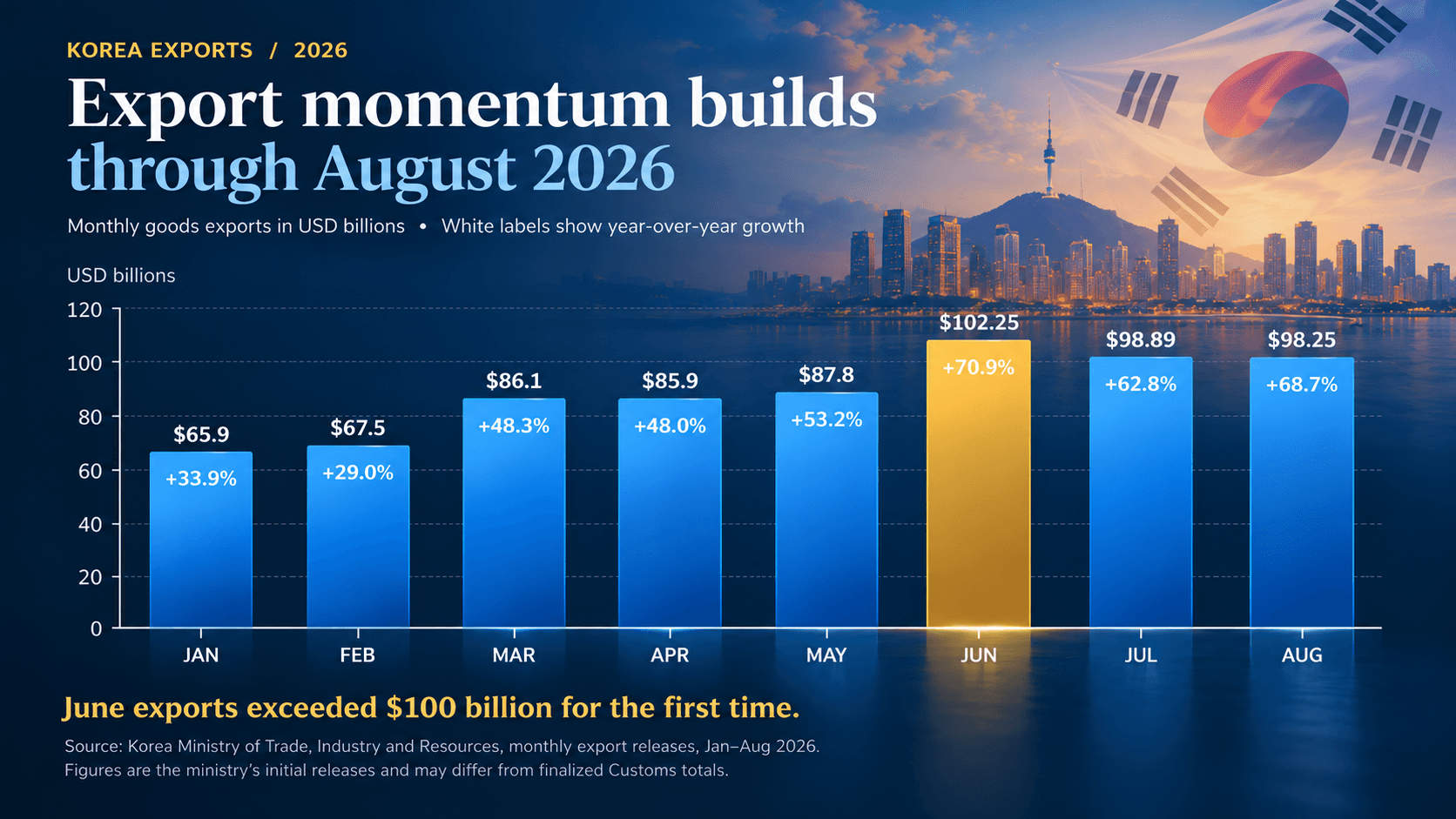
That makes the broader economic picture particularly interesting. Inflation has cooled from its post-pandemic highs and global trade remains uncertain, yet Korea’s economy grew 3.7% year over year in the second quarter, the Bank of Korea raised its 2026 growth forecast to 3.3%, and exports topped $100 billion in June for the first time.2
Helping drive those exports was one of Korea’s great industrial strengths: semiconductors.
The significance for investors extends well beyond the headline export numbers. Artificial intelligence is creating enormous demand for computing capacity, and every new AI data center requires advanced memory, substrates, printed circuit boards, electronic components and the specialized equipment needed to manufacture and test increasingly sophisticated chips. Korea makes a significant share of what this expansion requires.
For the Plus Korea Manufacturing Core Alliance Index ETF (KMCA), the result is a compelling connection between Korea’s economic resilience and the companies supplying the global AI and advanced-technology buildout.
Higher Rates Haven’t Stopped the Economy
Korea’s interest-rate and inflation picture deserves attention because monetary conditions can have an outsized influence on an economy so closely tied to global capital and trade.
Inflation eased to 2.8% in July, while the interest-rate gap between Korea and the United States has narrowed considerably from its widest point in recent years.3,4 That gap matters because relative interest rates can influence currencies and international capital flows, while moderating inflation can relieve pressure on households and businesses and give policymakers greater flexibility.
Yet perhaps the more interesting part of the story is that the economy has continued to grow. while rates have remained elevated. Exports have strengthened. And semiconductor demand has provided fresh momentum to a manufacturing sector that already supplies the world with everything from electronics and automobiles to batteries and industrial equipment.
For investors, Korea may offer something worth watching; signs of macroeconomic resilience at the same time that some of its most important industries are benefiting from a powerful new source of global demand.
AI Needs More Than Chips
The AI boom is often told through a handful of familiar technology companies. Follow the supply chain far enough, however, and the story quickly becomes one of manufacturing.
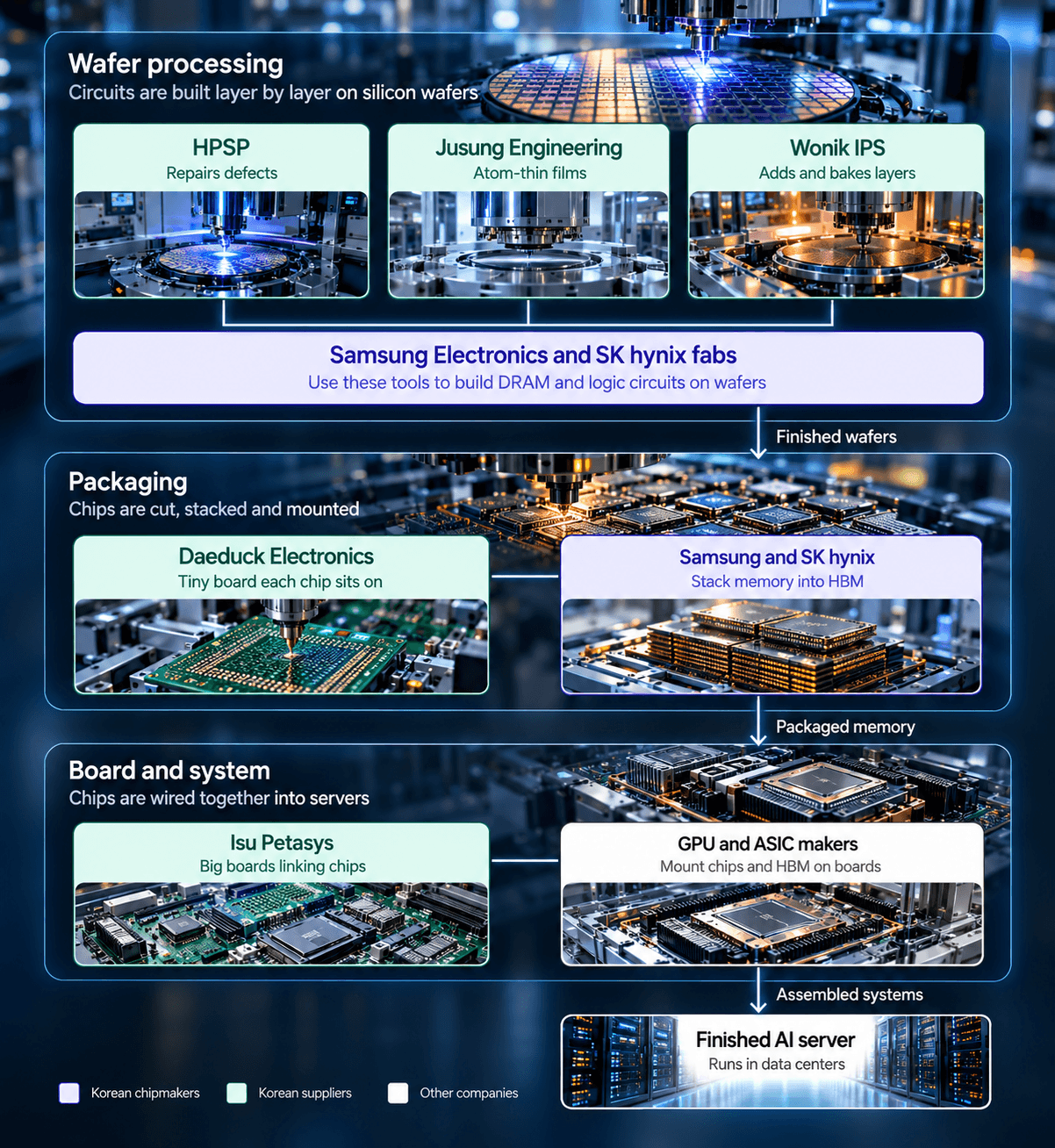
AI servers require enormous amounts of high-bandwidth memory. That memory must be fabricated using advanced semiconductor processes. The chips need increasingly sophisticated substrates and printed circuit boards. Expanding production requires specialized equipment, and every component eventually needs to be tested.
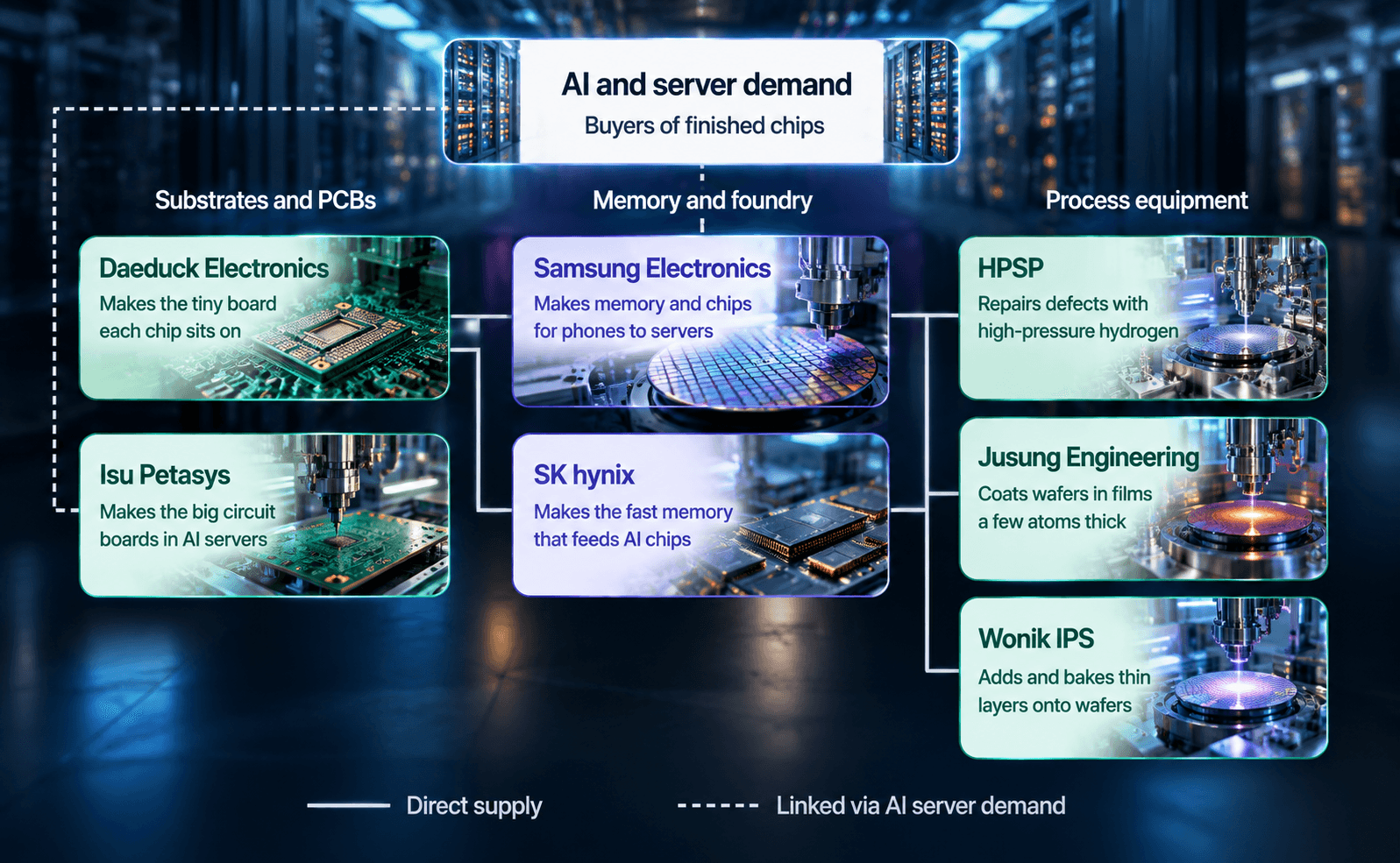
Korean companies in KMCA (as of 10/1/26) operate throughout that chain:
Samsung Electronics, KMCA’s largest holding among the companies highlighted here, combines major positions in DRAM and high-bandwidth memory (HBM) with one of the world’s leading semiconductor foundry businesses. SK Hynix has become a global leader in HBM, the advanced memory technology that has become critical to AI accelerators.
ISU Petasys makes advanced printed circuit boards used in AI servers and high-performance computing. Samsung Electro-Mechanics produces semiconductor substrates and other electronic components, while Daeduck Electronics manufactures advanced circuit boards and semiconductor components used in AI servers and other high-performance computing systems.
Behind every advanced chip is the specialized equipment required to manufacture and test it. KMCA holdings HPSP, Jusung Engineering and Wonik IPS supply equipment used throughout the semiconductor manufacturing process, and they seek to provide exposure to the investment required to make that expansion possible.
That is what may make Korea’s position particularly interesting. A dollar spent expanding AI infrastructure can potentially travel through multiple layers of the country’s manufacturing economy before the finished technology ever reaches a data center.
Korea’s Export Machine Has a New Driver
Korea has long been one of the world’s great exporting economies, and advanced computing is becoming an increasingly important part of that story.
Record semiconductor shipments are showing how global AI investment can translate into real manufacturing demand. That demand can reach beyond Samsung Electronics and SK Hynix to the network of component manufacturers, equipment suppliers and specialized technology companies supporting them.
The benefits also extend beyond the companies making the technology. Korea’s current-account surplus reached approximately $49.7 billion in June, following a $38.6 billion surplus in May, with the increase driven overwhelmingly by the country’s strong goods balance and semiconductor exports.5
That surplus provides Korea with an important external buffer. Strong exports generate foreign-exchange earnings and help the country finance its external position through trade rather than relying heavily on continuous inflows of foreign capital. For investors, that may add another dimension to Korea’s economic resilience: the same manufacturing strength driving corporate activity and export growth is also helping reinforce the country’s broader financial position.
This industrial depth did not appear overnight. Korea has spent decades developing manufacturing expertise, infrastructure and supply chains around semiconductors and electronics. Those capabilities are difficult to reproduce quickly, particularly as the technologies involved become more complex.
The result is an economy with meaningful exposure to one of the largest capital-investment cycles underway globally, supported by an external financial position that reflects the strength of its export engine.
What It May Mean for KMCA Investors
None of this makes Korea immune to economic cycles. Higher rates can still pressure consumers and corporate investment. Semiconductor demand has historically been cyclical. Korea also remains highly exposed to global trade, currency movements and changes in demand from its major export markets. Those risks are important, but so is the breadth of the opportunity.
KMCA seeks to provide exposure across Korea’s advanced manufacturing economy rather than relying on a single semiconductor company or technology. Within the semiconductor ecosystem alone, its holdings span memory and foundry leaders, component and substrate manufacturers, and the equipment companies helping chipmakers expand and modernize production.
The country’s improving growth and inflation picture may be attracting attention today. The bigger story is what Korea has spent decades building: a manufacturing ecosystem increasingly essential to AI, advanced computing and the next generation of global technology infrastructure.
And as the AI boom becomes a manufacturing boom, Korea offers a lot of what the world needs.
Holdings subject to change. To view holdings, click here.>>
Sources:
1. "Bank of Korea Raises 2026 Growth Forecast to 3.3% on AI Chip Exports," Korea JoongAng Daily, August 27, 2026.
2. "BOK Raises Key Rate for 2nd Consecutive Session to 3%, Revises Up 2026 Forecast to 3.3%," Korea Herald, August 27, 2026.
3. Bloomberg. "Korea's Inflation Cools More Than Expected, Offering Some Relief." August 4, 2026.
4. Seoul Economic Daily. "Korea Hikes Rate Ahead of US, Narrowing Gap to 1%P in 3.5 Years." July 16, 2026.
5. Xinhua. "S. Korea's Current Account Surplus Hits Record High in June." August 6, 2026.
Investors should consider the investment objectives, risks, charges and expenses carefully before investing. For a prospectus or summary prospectus with this and other information about the Fund, please call 1-855-900-0030 or visit our website at www.plusetf.com. Read the prospectus or summary prospectus carefully before investing.
Holdings are subject to change. For current holdings go to www.plusetf.com.
The Fund is distributed by Foreside Fund Services, LLC and Exchange Traded Concepts, LLC serves as the investment advisor of the funds. Foreside Fund Services, LLC is not affiliated with Exchange Traded Concepts, LLC or any of its affiliates.
Risk Disclosures:
Investing involves risk, including possible loss of principal. There is no guarantee the Fund will achieve their stated objectives. In addition to the normal risks associated with investing, international investments may involve the risk of capital loss from unfavorable fluctuation in currency values, differences in generally accepted accounting principles or social, economic or political instability in other nations. Emerging markets involve heightened risks related to the same factors as well as increased volatility and lower trading volume. The Fund’s concentration in an industry or sector can increase the impact of, and potential losses associated with, the risks from investing in those industries/sectors.
The Fund’s concentration in a single country or a limited number of countries will increase the impact of, and potential losses associated with, the risks from investing in those countries.
The Fund is non-diversified. The Fund is new and has a limited operating history for investors to evaluate. A new and smaller fund may not attract sufficient assets to achieve investment and trading efficiencies. In addition to the normal risks associated with investing, investments in smaller companies typically exhibit higher volatility.
The Fund may invest in securities denominated in foreign currencies. Because the Fund's NAV is determined in U.S. dollars, the Fund's NAV could decline if currencies of the underlying securities depreciate against the U.S. dollar or if there are delays or limits on repatriation of such currencies. Currency exchange rates can be very volatile and can change quickly and unpredictably.
The Fund is a recently organized investment company with no operating history. As a result, prospective investors have no track record or history on which to base their investment decision. Moreover, investors will not be able to evaluate the Fund against one or more comparable funds on the basis of relative performance until the Funds has established a track record.
One basis point (bps) is equivalent to 0.01%.


