South Korea has become one of the world's most important manufacturing economies. It is home to global leaders in semiconductors, batteries, shipbuilding, defense systems, advanced electronics, and industrial technology. Yet many investors seeking exposure to Korea through traditional country ETFs may be surprised to learn that they often receive only modest exposure to many of these industries.
 The reason lies in how broad market indices are constructed. Traditional Korea ETFs are designed to represent the country's equity market. As a result, they often allocate significant weight to mature sectors, financial institutions, consumer businesses, and diversified conglomerates whose fortunes are closely tied to domestic economic conditions. While these companies remain important components of the Korean economy, they may not fully reflect the industries driving Korea's increasing strategic importance within global supply chains.
For advisors and investors looking beyond simple country exposure, an important distinction emerges: investing in Korea is not necessarily the same as investing in the industries where Korea has developed world-class competitive advantages.
Today, several structural forces are reshaping global manufacturing. Artificial intelligence is driving unprecedented demand for advanced semiconductors and data-center infrastructure. Energy security concerns are supporting investment in LNG (Liquified Natural Gas) transportation, power infrastructure, and nuclear energy. Governments around the world are increasing defense spending. At the same time, automation and robotics are becoming increasingly important to industrial productivity. These are areas where Korean companies occupy critical positions.
The PLUS Korea Manufacturing Core Alliance Index ETF (KMCA) was designed around this reality. Rather than seeking to replicate the broad Korean equity market, KMCA focuses on six manufacturing pillars that sit at the center of Korea's global industrial leadership: AI semiconductors, batteries, shipbuilding, defense, power grid and nuclear energy, and robotics and automation.
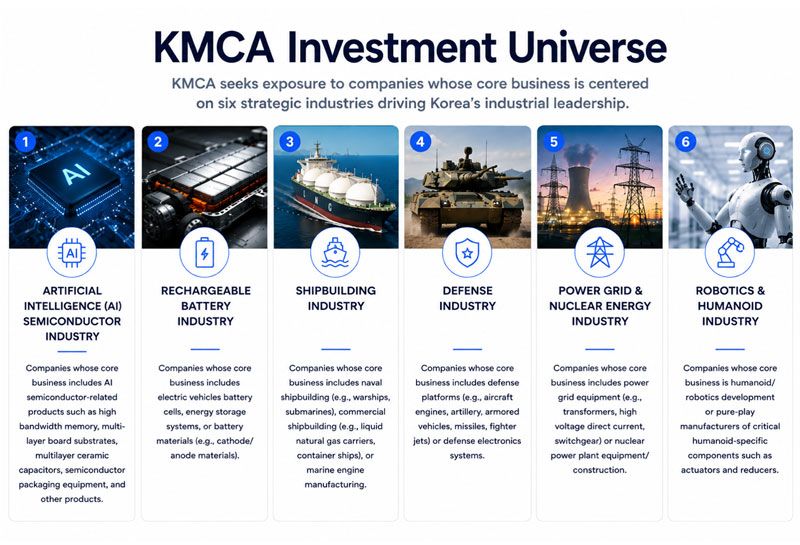
The portfolio's holdings help illustrate the difference.
SK Hynix, one of KMCA's largest positions (as of 7/8/26), has become a critical supplier of high-bandwidth memory used in AI accelerators and advanced computing systems. As global demand for AI infrastructure expands, memory has become one of the most important components within the semiconductor value chain.
Samsung Electronics and Samsung Electro-Mechanics (both as of 7/8/26) provide exposure to advanced semiconductor manufacturing, electronics components, and technology infrastructure that support both consumer and industrial applications. Together, these companies represent key links in the global technology ecosystem.
Beyond semiconductors, KMCA extends into industries that many investors may not immediately associate with Korea. The country has become a global leader in shipbuilding, LNG (Liquified Natural Gas) carrier construction, defense manufacturing, and increasingly, nuclear energy and industrial automation. These industries have benefited from a combination of engineering expertise, manufacturing scale and growing geopolitical relevance.
The result is a portfolio that may look fundamentally different from traditional Korea allocations. Sector exposure is concentrated in technology and industrial businesses directly tied to manufacturing, innovation, and global capital spending trends rather than broader domestic market representation.
South Korea's most compelling investment narrative in 2026 isn't "Korea is growing." It's more specific than that: the country has cultivated a set of industries - AI infrastructure, energy transition, defense, and maritime logistics - where it holds structural advantages that are extraordinarily difficult to replicate. HBM (High Bandwidth Memory) supply chains take years to build. LNG (Liquified Natural Gas) carrier expertise takes decades. Defense export relationships are built over generations.
For advisors building international allocations, this distinction may matter. Korea's future growth may not be evenly distributed across every sector of its economy. Increasingly, it appears concentrated within a select group of industries where Korean companies hold leading global positions and benefit from long-term structural demand.
KMCA seeks to provide access to those industries through a single investment vehicle.
Because in today's environment, the opportunity may be less about making a broad bet on Korea and more about gaining exposure to the industries where Korea's competitive advantages are most difficult to replicate.
Holdings subject to change. Click here to see what powers KMCA.
Investors should consider the investment objectives, risks, charges and expenses carefully before investing. For a prospectus or summary prospectus with this and other information about the Fund, please call 1-855-900-0030 or visit our website at www.plusetf.com. Read the prospectus or summary prospectus carefully before investing.
Holdings are subject to change. For current holdings go to www.plusetf.com.
The Fund is distributed by Foreside Fund Services, LLC and Exchange Traded Concepts, LLC serves as the investment advisor of the funds. Foreside Fund Services, LLC is not affiliated with Exchange Traded Concepts, LLC or any of its affiliates.
Risk Disclosures:
Investing involves risk, including possible loss of principal. There is no guarantee the Fund will achieve their stated objectives. In addition to the normal risks associated with investing, international investments may involve the risk of capital loss from unfavorable fluctuation in currency values, differences in generally accepted accounting principles or social, economic or political instability in other nations. Emerging markets involve heightened risks related to the same factors as well as increased volatility and lower trading volume. The Fund’s concentration in an industry or sector can increase the impact of, and potential losses associated with, the risks from investing in those industries/sectors.
The Fund’s concentration in a single country or a limited number of countries will increase the impact of, and potential losses associated with, the risks from investing in those countries.
The Fund is non-diversified. The Fund is new and has a limited operating history for investors to evaluate. A new and smaller fund may not attract sufficient assets to achieve investment and trading efficiencies. In addition to the normal risks associated with investing, investments in smaller companies typically exhibit higher volatility.
The Fund may invest in securities denominated in foreign currencies. Because the Fund's NAV is determined in U.S. dollars, the Fund's NAV could decline if currencies of the underlying securities depreciate against the U.S. dollar or if there are delays or limits on repatriation of such currencies. Currency exchange rates can be very volatile and can change quickly and unpredictably.
The Fund is a recently organized investment company with no operating history. As a result, prospective investors have no track record or history on which to base their investment decision. Moreover, investors will not be able to evaluate the Fund against one or more comparable funds on the basis of relative performance until the Funds has established a track record.
One basis point (bps) is equivalent to 0.01%.


