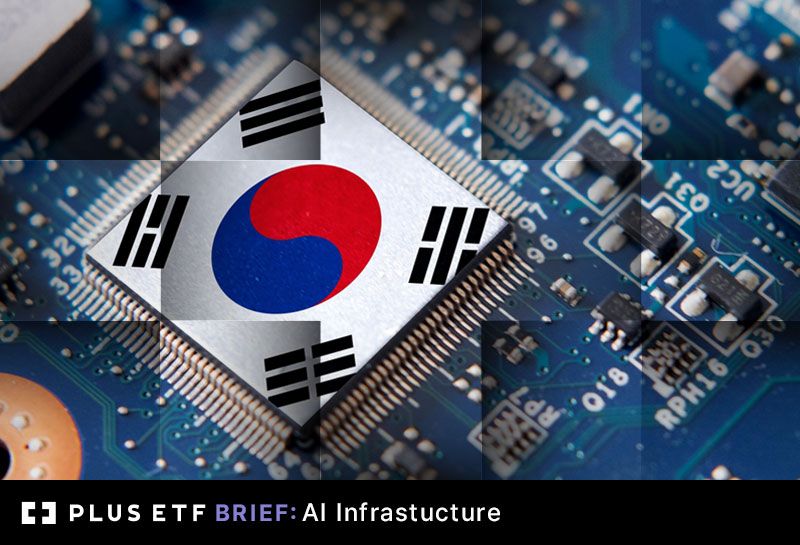
AI is not ultimately a software story. It is a story about who builds the hardware.
Every large language model that writes code, every image generator that creates content, and every autonomous system that navigates the physical world depends on something much more tangible than software alone.
AI requires enormous amounts of memory, electricity, industrial equipment, transportation infrastructure, and advanced manufacturing capabilities. Behind every breakthrough model sits a vast network of companies supplying the physical foundation that makes AI possible. That foundation runs, to a remarkable degree, through South Korea.1
The PLUS Korea Manufacturing Core Alliance Index ETF (KMCA) seeks exposure to many of the industries helping support this infrastructure buildout, from semiconductors and power equipment to robotics, shipbuilding, and advanced manufacturing.
The Memory That Powers AI
The AI revolution begins with computation, and computation begins with memory. One of the most critical technologies enabling modern AI is High Bandwidth Memory (HBM), a specialized type of memory that allows AI accelerators to move and process massive amounts of data at extraordinary speeds. Without HBM, many of today's most advanced AI models simply could not operate efficiently.
South Korea sits at the center of this market. SK Hynix has been the primary HBM supplier for Nvidia's H100 and H200 AI accelerators and is expected to supply approximately two-thirds of Nvidia's next-generation HBM4 demand for its Rubin platform, while Samsung is positioned to supply much of the remainder. ² As AI investment accelerates across companies such as Nvidia, AMD, Google, and Microsoft, demand for HBM has grown rapidly, with Korean manufacturers expected to maintain a dominant share of global supply through at least 2026.³
When a hyperscale data center operator expands its AI infrastructure, there is a strong likelihood that Korean-made memory is helping power those systems. KMCA holds both companies (as of 7/8/26) among its core positions, providing exposure to a key segment of the AI infrastructure value chain.
AI Needs More Than Chips. It Needs Power.
Training and operating AI models requires enormous amounts of electricity. A single large-scale data center can consume as much power as a small city, and growing AI adoption is increasing demand for energy infrastructure throughout the world. That demand extends far beyond power generation itself. It includes transformers, switchgear, transmission equipment, energy storage systems, and the infrastructure needed to move electricity reliably from source to server.
Several Korean companies in KMCA (as of 7/8/26) operate directly within these critical segments:
LS ELECTRIC manufactures high-voltage switchgear and distribution transformers used in hyperscale data centers across North America. In 2026, the company secured more than $338 million in data center-related orders from major technology clients.⁴
Hyundai Electric & Energy Systems has also benefited from rising demand for grid infrastructure. The company reported record operating profit in 2025, entered 2026 with a substantial order backlog, and expanded its U.S. manufacturing footprint to help meet growing demand for ultra-high-voltage transformers.⁵
These companies represent an important layer of the AI ecosystem that often receives less attention than semiconductors but remains essential to enabling large-scale AI deployment.
Building the Factories Behind the Future
Between the semiconductor and the finished AI model lies another critical layer: advanced manufacturing. The chips powering AI must be designed, fabricated, assembled, tested, and packaged using highly specialized industrial equipment. As AI demand grows, so does demand for the machinery that enables semiconductor production.
One example is Wonik IPS, a KMCA holding as of 7/8/26, that manufactures atomic layer deposition (ALD) and chemical vapor deposition (CVD) systems used in semiconductor fabrication. These technologies help create the complex layered structures required for advanced HBM memory, making them an important part of the manufacturing process behind modern AI accelerators. SK Hynix and Samsung are among its primary customers.⁶ As next-generation HBM adoption expands, industry analysts have identified companies such as Wonik IPS as potential beneficiaries of continued investment in advanced memory production.⁷
This layer of the value chain illustrates an important point for investors: AI is creating demand for chips and demand for the tools required to manufacture those chips.
The Logistics Network Behind Global AI
The physical AI economy also depends on the movement of energy, raw materials, and manufactured goods around the world.
Liquefied natural gas (LNG) remains an important component of global electricity generation, particularly as countries seek reliable power sources capable of supporting rising data center demand. Moving LNG requires highly specialized vessels, an area where South Korea has developed significant expertise.
South Korean shipbuilders, including HD Hyundai Heavy Industries (a KMCA holding as of 7/8/26), hold leading positions in the global LNG carrier market. These vessels play an important role in transporting energy supplies that help support industrial activity and electricity generation worldwide.
By including exposure to sectors such as shipbuilding, semiconductors, batteries, defense, and industrial manufacturing, KMCA seeks to capture multiple components of the infrastructure supporting global economic growth and technological development.
A Structural Theme Across the Entire Portfolio
The AI economy is built on more than algorithms and software. It depends on memory, energy, manufacturing, automation, and global supply chains working together at scale. South Korea plays an important role across many of these industries and KMCA seeks exposure to companies participating in the physical infrastructure that helps support the development and deployment of AI technologies.
We are not simply offering Korea beta*. We are providing access to Korea's structural industrial alpha.*
* Beta: Beta generally refers to returns that are driven by broad market or sector exposure. For example, an investor seeking Korea beta is typically looking for exposure to the overall performance of the Korean equity market.
*Alpha: Alpha generally refers to returns that exceed a benchmark's performance and are often attributed to factors such as security selection, portfolio construction, or exposure to specific investment themes.
Holdings subject to change. To view holdings, click here https://plusetf.com/kmca
Sources:
1 Korea Herald, "AI Fuels Korea Tech in 2026 as China Squeezes Steel, Petrochemicals," The Korea Herald, December 14, 2025.
² TrendForce, "SK Hynix Reportedly to Supply About Two-Thirds of NVIDIA HBM4; Samsung Targets Early Delivery," TrendForce News, January 28, 2026.
³ Ibid. See also Tom's Hardware, "SK Hynix Expands U.S. Presence with New Bellevue, Seattle Office," Tom's Hardware, December 24, 2025.
⁴ AJU Press, "LS Electric Secures $70 Million Power Distribution Contract for North American AI Data Centers," AJU Press, June 17, 2026. See also Data Centre & Network News, "LS Electric Wins $115m Data Centre Contract," DCNN Magazine, April 16, 2026.
⁵ BigGo Finance, "AI Data Center Boom Drives HD Hyundai Electric to Near 1 Trillion Won in Annual Operating Profit," BigGo Finance, February 5, 2026. See also Transformer Magazine, "HD Hyundai Electric Breaks Ground on Second U.S. Transformer Plant," Transformer Magazine, April 27, 2026.
⁶ "Why AI Chip Manufacturing Depends on Companies Nobody Has Heard Of," KoreaPlus, May 22, 2026.
⁷ Investing.com, "This Korean Chip Equipment Stock Is Best Positioned for the AI Memory Boom: Macquarie," Investing.com, April 21, 2026.
Investors should consider the investment objectives, risks, charges and expenses carefully before investing. For a prospectus or summary prospectus with this and other information about the Fund, please call 1-855-900-0030 or visit our website at www.plusetf.com. Read the prospectus or summary prospectus carefully before investing.
Holdings are subject to change. For current holdings go to www.plusetf.com.
The Fund is distributed by Foreside Fund Services, LLC and Exchange Traded Concepts, LLC serves as the investment advisor of the funds. Foreside Fund Services, LLC is not affiliated with Exchange Traded Concepts, LLC or any of its affiliates.
Risk Disclosures:
Investing involves risk, including possible loss of principal. There is no guarantee the Fund will achieve their stated objectives. In addition to the normal risks associated with investing, international investments may involve the risk of capital loss from unfavorable fluctuation in currency values, differences in generally accepted accounting principles or social, economic or political instability in other nations. Emerging markets involve heightened risks related to the same factors as well as increased volatility and lower trading volume. The Fund’s concentration in an industry or sector can increase the impact of, and potential losses associated with, the risks from investing in those industries/sectors.
The Fund’s concentration in a single country or a limited number of countries will increase the impact of, and potential losses associated with, the risks from investing in those countries.
The Fund is non-diversified. The Fund is new and has a limited operating history for investors to evaluate. A new and smaller fund may not attract sufficient assets to achieve investment and trading efficiencies. In addition to the normal risks associated with investing, investments in smaller companies typically exhibit higher volatility.
The Fund may invest in securities denominated in foreign currencies. Because the Fund's NAV is determined in U.S. dollars, the Fund's NAV could decline if currencies of the underlying securities depreciate against the U.S. dollar or if there are delays or limits on repatriation of such currencies. Currency exchange rates can be very volatile and can change quickly and unpredictably.
The Fund is a recently organized investment company with no operating history. As a result, prospective investors have no track record or history on which to base their investment decision. Moreover, investors will not be able to evaluate the Fund against one or more comparable funds on the basis of relative performance until the Funds has established a track record.
One basis point (bps) is equivalent to 0.01%.


