When investors think about artificial intelligence, they tend to think about the companies at the top of the stack: the chip designers, the model builders, the hyperscalers. But AI is not, at its core, a software story. It is a story about who builds the hardware.
Before a single AI model can answer a prompt, a vast physical supply chain has to be built first. A new data center needs semiconductors and the equipment to manufacture them. It needs power, and the grid infrastructure to deliver that power reliably. It needs backup energy storage, the ships that move fuel and components around the world, and increasingly, the robots and automation systems building the factories that make all of it possible.
Call it the Industrial Multiplier: every dollar invested in AI infrastructure sets off a chain reaction across the physical economy, and that chain reaction runs, to a striking degree, through South Korea.
The PLUS Korea Manufacturing Core Alliance Index ETF (KMCA) is built around that thesis, holding a concentrated set of Korean companies across six sectors: AI semiconductors, rechargeable batteries, shipbuilding, defense, power grid and nuclear energy, and robotics and humanoids.¹ Here is what that ripple effect looks like, sector by sector, through companies actually held in the fund as of 10/1/26.
Semiconductors: the memory AI runs on
Every large model depends on High Bandwidth Memory (HBM), the specialized chip technology that lets AI accelerators move enormous amounts of data at speed. That demand runs straight through KMCA's two largest positions:
SK Hynix has been the primary HBM supplier for Nvidia's H100 and H200 accelerators and is expected to supply roughly two-thirds of Nvidia's next-generation HBM4 demand for its Rubin platform.²
Samsung Electronics, KMCA's single largest holding, is positioned to supply much of the remaining HBM4 demand and has already begun shipping 12-layer HBM4E samples to major customers.²
But memory is only half the story once a chip leaves the semiconductor factory. It still has to be mounted, wired, and packaged onto a board robust enough to move data at AI speeds, and that's where two more KMCA holdings sit:
ISU Petasys, KMCA's second-largest holding, is the world's leading maker of ultra-high-layer printed circuit boards (18 or more layers, and up to 30+) used inside AI servers and accelerators, with customers including Alphabet, Nvidia, and Microsoft. The company is projected to surpass ₩1 trillion in annual sales for the first time as orders from global hyperscalers concentrate on it.³
Daeduck Electronics, Korea’s first printed circuit board (PCB) manufacturer has developed a larger chip-packaging component known as a flip-chip ball grid array (FCBGA) for AI servers and data centers. The component helps connect powerful central processing units (CPUs) and graphics processing units (GPUs) within advanced packaging systems such as Chip-on-Wafer-on-Substrate (CoWoS). It is projected to see sales grow more than 25% in 2026 on AI-driven demand.⁴
Semiconductor Equipment/Component Manufacturing: building the tools that build the chips
Between raw semiconductors and a finished AI accelerator sits an equipment layer that gets far less attention. KMCA holds three of the companies that make it:
Wonik IPS manufactures the atomic layer deposition (ALD) and chemical vapor deposition (CVD) systems used to fabricate the complex layered structures inside advanced HBM memory, with SK Hynix and Samsung among its primary customers.⁵
Jusung Engineering builds its own ALD and CVD deposition equipment used in DRAM capacitor processes, the kind of advanced memory manufacturing step that scales directly with HBM demand.⁶
HPSP holds what amounts to a global monopoly in high-pressure hydrogen annealing equipment, a process used by both logic and memory chipmakers to reduce defects and improve chip performance in advanced-node production and reportedly runs some of the highest operating margins of any Korean equipment maker.⁷
It's a reminder that AI demand doesn't just lift chipmakers, it lifts the entire toolchain behind them.
Power grid and transformers: the bottleneck nobody talks about
A single large AI data center can draw as much electricity as a small city, and that demand must move from source to server through transformers, switchgear, and transmission equipment. Two KMCA holdings sit directly in that path:
LS Electric manufactures the high-voltage switchgear and distribution transformers used in hyperscale data centers across North America and secured more than $338 million in data-center-related orders in 2026 alone.⁸
HD Hyundai Electric & Energy Systems has seen a similar surge, reporting record operating profit and expanding its U.S. manufacturing footprint to meet growing demand for ultra-high-voltage transformers.⁹
Nuclear: reliable baseload for an always-on grid
Data centers need firm, round-the-clock power, not just more of it, and nuclear has become a central part of how AI operators are trying to secure that reliability.
Doosan Enerbility, one of KMCA’s larger holdings, has a role in several parts of the power generation buildout. Its manufacturing capabilities span established nuclear plants, emerging small modular reactors (SMRs) and gas turbines, each relevant to growing electricity demand.
Large-scale nuclear power: Doosan manufactures major plant components, including reactor vessels and steam generators. It has supplied components to more than 80 nuclear plants worldwide and holds a leading position in South Korea's own nuclear steam supply systems.10
Small modular reactors: Doosan has reserved forging capacity for components intended for 16 X-energy reactors, signed a manufacturing contract for TerraPower’s Natrium project and begun manufacturability reviews for Rolls-Royce SMR projects in the UK and Czech Republic.10
Gas and steam turbines: Doosan is the first company and the fifth company worldwide to develop its own large-scale gas turbine technology. Its 380 MW gas turbines have been ordered for U.S. data centers, while separate steam turbine and generator orders extend its role in gas-fired power projects.11
That breadth is reflected in its order book: Doosan reported a ₩26.35 trillion (about $18.1 billion) backlog at the end of the first half of 2026 and has projected that its backlog could reach approximately ₩48 trillion by 2030. The latter figure is a company forecast, rather than contracted orders already in hand.19
It's a clean illustration of the multiplier at work: AI's appetite for always-on power is turning into multi-year order books for the company building the reactors behind it.
Batteries: energy storage as insurance
Data centers and grid operators increasingly lean on large-scale battery storage to smooth demand and provide backup power. Two KMCA holdings are building directly for that need:
LG Energy Solution built a next-generation smart factory for its 46-series cylindrical batteries around digital-twin manufacturing, modeling production changes virtually before they hit the physical line.¹²
Samsung SDI is marketing directly to AI data center operators, with high-power uninterruptible power supply (UPS) and battery backup unit (BBU) batteries designed to keep power flowing during outages, plus its Samsung Battery Box energy storage system now being manufactured in the U.S. to meet rising demand.¹³
It's the same AI-driven manufacturing playbook showing up in the battery supply chain that ultimately backstops the grid.
Ships: the logistics layer of the energy economy
Moving the LNG that fuels much of the world's power generation, including the electricity feeding data centers, requires highly specialized vessels. South Korea's three largest shipbuilders, all KMCA holdings, hold leading positions in that market:
HD Hyundai Heavy Industries
Samsung Heavy Industries
Hanwha Ocean¹⁴
Energy logistics is an unglamorous but essential link between where power is generated and where AI infrastructure runs.
Defense: dual-use manufacturing muscle
Korea's defense sector is becoming a testing ground for the same automation and physical-AI technologies reshaping the rest of KMCA's holdings:
Hanwha Aerospace, KMCA's fifth-largest holding, has formed a $1.5 billion physical-AI joint venture with gaming company Krafton, pairing its defense and manufacturing infrastructure with Krafton's simulation technology, while also integrating AI into the unmanned ground vehicles used across its own production lines.¹⁵
Korea Aerospace Industries (KAI), maker of the KF-21 fighter and FA-50 light attack jet, is developing an AI-based manned-unmanned teaming system alongside a backlog anchored by multi-year export contracts.¹⁶
Hyundai Rotem, best known for the K2 battle tank, is developing its own unmanned robotics based on physical AI, extending its tracked-vehicle engineering expertise into the same autonomous-systems push underway across the fund.¹⁶
Defense-grade manufacturing discipline is becoming a template for industrial automation more broadly.
Robotics: the hands and eyes of the autonomous factory
This is where the thesis becomes tangible. Four KMCA holdings span the components, the platforms, and the deployment of physical AI on the factory floor:
Rainbow Robotics, a robotics maker backed by Samsung Electronics, produces core components for collaborative robots and humanoid platforms.
ROBOTIS makes the actuators and control systems that give robots precise movement.
Hyundai Motor took full ownership of Boston Dynamics in 2026 and plans to deploy the Atlas humanoid robot on its own factory floors starting in 2028, scaling toward 30,000 units a year by 2030.
Hyundai Mobis has developed its own mobile collaborative robots, autonomous logistics robots, and wearable exoskeletons for factory workers.¹⁷
Automation: the factories making tomorrow's infrastructure
The automation story is not confined to any one sector, it's the connective tissue running through all of them.
Samsung Electronics is converting its global manufacturing footprint into "AI-Driven Factories" by 2030, layering digital twins and AI agents across quality control and logistics. SK Hynix is targeting a fully autonomous fab by the same year, built with NVIDIA on fab-wide digital twins. HD Hyundai's AI-powered welding robots have lifted shipyard output from roughly 500 to 750 tons a day, and Samsung Heavy Industries has partnered with Rainbow Robotics to build welding robots that operate autonomously inside ship blocks.¹⁸ The same automation wave sweeping AI infrastructure is now sweeping the factories that build it.
Where The Multiplier Meets The Market
That one-dollar chain reaction is the point. A dollar spent on an AI accelerator does not stop at the chip. It can translate into demand for ISU Petasys substrates and Wonik IPS deposition equipment, followed by the power infrastructure required to support it, including LS Electric switchgear and Doosan Enerbility reactor components.
The broader buildout can extend further still, supporting batteries from LG Energy Solution and Samsung SDI, LNG carriers from HD Hyundai Heavy Industries, welding robots from Rainbow Robotics and humanoid platforms from Hyundai Motor.
Viewing AI as a single-sector trade concentrated in a handful of U.S. software and semiconductor companies risks potentially overlooking much of the industrial ecosystem forming around it.
KMCA seeks to capture that full industrial cascade in one fund, concentrated in a country, South Korea, that sits at the physical center of it.
Holdings subject to change. To view holdings, click here.>>
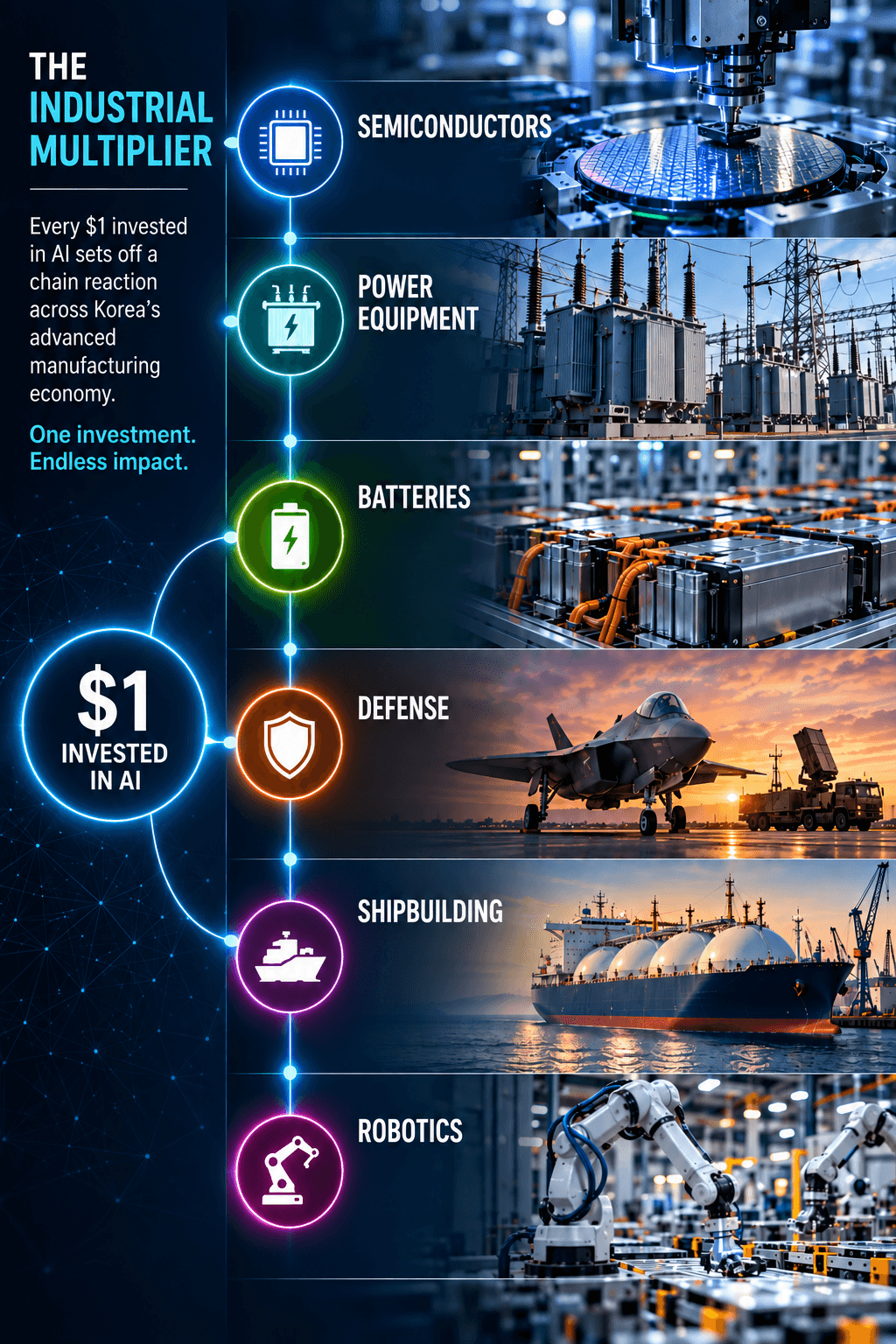
Conceptual infographic created by the author. For illustrative purposes only.
Sources
Exchange Traded Concepts / Hanwha Asset Management, PLUS Korea Manufacturing Core Alliance Index ETF (KMCA) fund materials, plusetf.com.
TrendForce, "SK Hynix Reportedly to Supply About Two-Thirds of NVIDIA HBM4; Samsung Targets Early Delivery," January 28, 2026; TSPA Semiconductor, "Who Controls HBM Controls the AI Semiconductor Era," June 30, 2026.
Forbes, "AI Chip Boom Propels Chairman Of Korean Circuit Board Maker Into The Billionaire Ranks," October 16, 2025; BigGo Finance, "AI Semiconductor's 'Hidden Key Player' ISU PETASYS Poised to Surpass 1 Trillion Won in Sales as Global Big Tech Orders Surge," January 27, 2026.
BusinessWire, "Daeduck Electronics Developed Large Body FCBGA Substrate for Data Centers," June 24, 2024; Grokipedia, "Daeduck Electronics," accessed September 2026.
"Why AI Chip Manufacturing Depends on Companies Nobody Has Heard Of," KoreaPlus, May 22, 2026; Investing.com, "This Korean Chip Equipment Stock Is Best Positioned for the AI Memory Boom: Macquarie," April 21, 2026.
BALD Engineering, "Born in Finland, Born to ALD: ALD Equipment," accessed September 2026; The Elec, "Jusung Engineering's New Hybrid ALD Equipment in Customer Testing."
THE ELEC, "HPA System Supplier HPSP Reaches Operating Margin Rate of 53.7%," August 21, 2025; imec, "HPSP Expands Its R&D Capabilities and Study on HPA and HPO," January 15, 2024.
AJU Press, "LS Electric Secures $70 Million Power Distribution Contract for North American AI Data Centers," June 17, 2026; DCNN Magazine, "LS Electric Wins $115m Data Centre Contract," April 16, 2026.
BigGo Finance, "AI Data Center Boom Drives HD Hyundai Electric to Near 1 Trillion Won in Annual Operating Profit," February 5, 2026; Transformer Magazine, "HD Hyundai Electric Breaks Ground on Second U.S. Transformer Plant," April 27, 2026.
POWER Magazine, "X-energy, Doosan Lock In 16-Unit Xe-100 Component Reservation as Doosan Commits to New SMR Factory," December 18, 2025; World Nuclear News, "Škoda JS, Doosan Enerbility Get Key Rolls-Royce SMR Work," June 30, 2026; TechTimes, "Doosan Enerbility Wins Rolls-Royce SMR Work: Q1 Orders Jump 62% Amid Data Center Push," May 31, 2026.
Doosan Enerbility, “Doosan Enerbility Secures First Overseas Export of Gas Turbine to U.S. Market,” October 13, 2025.
The Korea Times, "LG Energy Solution Leads Battery Industry's Shift To AI-Driven Manufacturing," May 25, 2026.
Korea Herald, "Samsung SDI to Unveil High-Power Batteries for AI at InterBattery 2026," March 3, 2026; Energy-Storage.News, "Samsung SDI to Start US BESS Manufacturing from 2026," September 17, 2025.
PLUS ETF insight, "The AI Infrastructure Race Has a Supply Chain. Korea Runs It.," July 30, 2026.
The Korea Times, "Hanwha Aerospace Partners With Gaming Giant Krafton To Develop Physical AI," March 13, 2026.
The Herald Business, "K-defense Order Backlogs Slip as New Export Deals Dry Up," August 10, 2026.
Silicon Republic, "Hyundai to Take Full Ownership of Boston Dynamics," July 2026; KED Global, "Hyundai to Build $6.3 Billion AI, Robotics, Hydrogen Hub in South Korea," February 27, 2026.
Samsung Newsroom, "Samsung Electronics Announces Strategy To Transition Global Manufacturing Into 'AI-Driven Factories' by 2030," February 28, 2026; Seoul Economic Daily, "SK Hynix to Build Self-Learning 'Autonomous Fab' by 2030," March 18, 2026.
Doosan Enerbility Co., Ltd., FY2025 Earnings Release and Business Outlook (February 12, 2026).
Investors should consider the investment objectives, risks, charges and expenses carefully before investing. For a prospectus or summary prospectus with this and other information about the Fund, please call 1-855-900-0030 or visit our website at www.plusetf.com. Read the prospectus or summary prospectus carefully before investing.
Holdings are subject to change. For current holdings go to www.plusetf.com.
The Fund is distributed by Foreside Fund Services, LLC and Exchange Traded Concepts, LLC serves as the investment advisor of the funds. Foreside Fund Services, LLC is not affiliated with Exchange Traded Concepts, LLC or any of its affiliates.
Risk Disclosures:
Investing involves risk, including possible loss of principal. There is no guarantee the Fund will achieve their stated objectives. In addition to the normal risks associated with investing, international investments may involve the risk of capital loss from unfavorable fluctuation in currency values, differences in generally accepted accounting principles or social, economic or political instability in other nations. Emerging markets involve heightened risks related to the same factors as well as increased volatility and lower trading volume. The Fund’s concentration in an industry or sector can increase the impact of, and potential losses associated with, the risks from investing in those industries/sectors.
The Fund’s concentration in a single country or a limited number of countries will increase the impact of, and potential losses associated with, the risks from investing in those countries.
The Fund is non-diversified. The Fund is new and has a limited operating history for investors to evaluate. A new and smaller fund may not attract sufficient assets to achieve investment and trading efficiencies. In addition to the normal risks associated with investing, investments in smaller companies typically exhibit higher volatility.
The Fund may invest in securities denominated in foreign currencies. Because the Fund's NAV is determined in U.S. dollars, the Fund's NAV could decline if currencies of the underlying securities depreciate against the U.S. dollar or if there are delays or limits on repatriation of such currencies. Currency exchange rates can be very volatile and can change quickly and unpredictably.
The Fund is a recently organized investment company with no operating history. As a result, prospective investors have no track record or history on which to base their investment decision. Moreover, investors will not be able to evaluate the Fund against one or more comparable funds on the basis of relative performance until the Funds has established a track record.
One basis point (bps) is equivalent to 0.01%.


