Defense investing is still widely misunderstood.
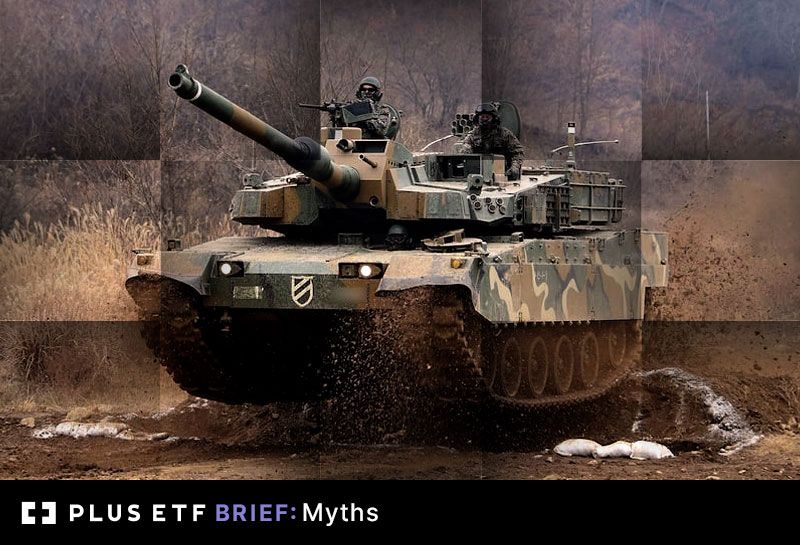 For many investors, defense ETFs function like a geopolitical mood ring: tensions rise, defense rallies; tensions fade, returns stall. It’s a simple framework - reinforced by decades of headline-driven market moves - and one that no longer reflects how global defense markets work.
From Episodic Demand to Structural Rearmament
The world has entered a different phase. Global defense is shifting from episodic demand to structural demand. World military expenditure rose to $2.7718 billion in 2024, meaning that spending has increased every year for a full decade, going up by 37 per cent between 2015 and 2024. The 9.4 per cent increase in 2024 was the steepest year-on-year rise since at least 1988. The global military burden (the share of the world’s gross domestic product (GDP) devoted to military expenditure) increased to 2.5 per cent in 2024. Average military expenditure as a share of government expenditure rose to 7.1 per cent in 2024 and world military spending per person was the highest since 1990, at $334. [1]
Today’s defense cycle is not about reacting to isolated conflicts, but about correcting years of underinvestment. Stockpiles are depleted. Production capacity is constrained. Governments are planning around multi-year rearmament, not short-term crises. That shift quietly undermines several assumptions investors continue to make about defense exposure.
Myth #1: Defense ETFs Only Perform During Conflicts
The first myth is that defense ETFs only perform when conflicts escalate. Markets are increasingly pricing procurement visibility, not battlefield volatility. Orders placed today often won’t be delivered for years, and companies with the ability to manufacture at scale, right now, are benefiting regardless of daily headlines. Structural demand, not episodic fear, is becoming the dominant driver.
Myth #2: International Defense Firms Lack Transparency
The second misconception is that international defense firms lack transparency. While some markets still warrant caution, the blanket assumption no longer holds. Many non-U.S. defense companies operate under public reporting standards, face multilayered export oversight, and announce major contracts openly. For investors, visibility increasingly comes from order backlogs and government-to-government deals rather than opaque domestic programs.
Myth 3: All Defense Exposure Is Essentially the Same
A third - and more consequential - mistake is assuming all defense exposure is essentially the same as owning U.S. defense primes. U.S. contractors tend to be anchored to long-cycle, platform-heavy programs. Much of today’s urgent global demand, however, is far more practical: land systems, armored vehicles, artillery, and munitions - the unglamorous assets that modern conflicts consume at scale. The war in Ukraine didn’t just reshape security priorities; it exposed how quickly equipment is depleted and how slow many supply chains really are.
Why South Korea Breaks the Mold
Korea’s defense industry was built with manufacturing efficiency and scalability at its core. Its leading companies combine modern electronics, cost discipline, and rapid production timelines -precisely the qualities governments now prioritize as they rebuild readiness. As Europe and other regions accelerate rearmament, Korea has emerged not as a stopgap supplier, but as a strategic partner capable of delivering quickly and consistently.
The Overlooked Reality of Defense Innovation
Another persistent myth is that defense companies don’t innovate. That belief usually equates innovation with breakthrough aircraft or classified systems. In reality, today’s innovation often shows up in production engineering, autonomy, sensors, and platform upgrades. In an era focused on readiness rather than experimentation, this kind of “quiet innovation” is increasingly valuable and frequently underappreciated by investors.
Rethinking Defense ETFs in a New Cycle
Taken together, these shifts suggest a reframing of defense ETFs is overdue. The key question is no longer just where conflicts may flare up, but who can reliably deliver hardware at scale. That distinction favors countries with deep industrial capacity, export credibility, and alignment with allied defense needs.
This is the rationale behind the PLUS Korea Defense Industry Index ETF (KDEF) - a U.S.-listed ETF that seeks to provide targeted exposure to South Korea’s defense ecosystem. Rather than mirroring U.S. defense allocations, KDEF offers access to a differentiated set of companies positioned at the center of global rearmament trends.
For advisors and investors willing to challenge conventional thinking, KDEF represents a way to participate in defense as a structural allocation, not merely a headline-driven trade.
To learn more about the PLUS Korea Defense Industry Index ETF (KDEF) and how Korean defense fits into the evolving global security landscape, explore the full investment thesis and fund details here. >>
[1] Liang, Xiao et al, Trends In World Military Expenditure 2024, Stockholm International Peace Research Insitute, SIPRI.org, April 2024.
Investors should consider the investment objectives, risks, charges and expenses carefully before investing. For a prospectus or summary prospectus with this and other information about the Fund, please call 1-855-900-0030 or visit our website at www.plusetf.com. Read the prospectus or summary prospectus carefully before investing.
Holdings are subject to change. For current holdings go to www.plusetf.com.
The Fund is distributed by Foreside Fund Services, LLC and Exchange Traded Concepts, LLC serves as the investment advisor of the funds. Foreside Fund Services, LLC is not affiliated with Exchange Traded Concepts, LLC or any of its affiliates.
Risk Disclosures:
Investing involves risk, including possible loss of principal. There is no guarantee the Fund will achieve their stated objectives. In addition to the normal risks associated with investing, international investments may involve the risk of capital loss from unfavorable fluctuation in currency values, differences in generally accepted accounting principles or social, economic or political instability in other nations. Emerging markets involve heightened risks related to the same factors as well as increased volatility and lower trading volume. The Fund’s concentration in an industry or sector can increase the impact of, and potential losses associated with, the risks from investing in those industries/sectors.
The Fund’s concentration in a single country or a limited number of countries will increase the impact of, and potential losses associated with, the risks from investing in those countries.
The Fund is non-diversified. The Fund is new and has a limited operating history for investors to evaluate. A new and smaller fund may not attract sufficient assets to achieve investment and trading efficiencies. In addition to the normal risks associated with investing, investments in smaller companies typically exhibit higher volatility.
The Fund may invest in securities denominated in foreign currencies. Because the Fund's NAV is determined in U.S. dollars, the Fund's NAV could decline if currencies of the underlying securities depreciate against the U.S. dollar or if there are delays or limits on repatriation of such currencies. Currency exchange rates can be very volatile and can change quickly and unpredictably.
The Fund is a recently organized investment company with no operating history. As a result, prospective investors have no track record or history on which to base their investment decision. Moreover, investors will not be able to evaluate the Fund against one or more comparable funds on the basis of relative performance until the Funds has established a track record.
One basis point (bps) is equivalent to 0.01%.


