South Korea is taking a bold swing at an unlikely target: reviving American shipyards.
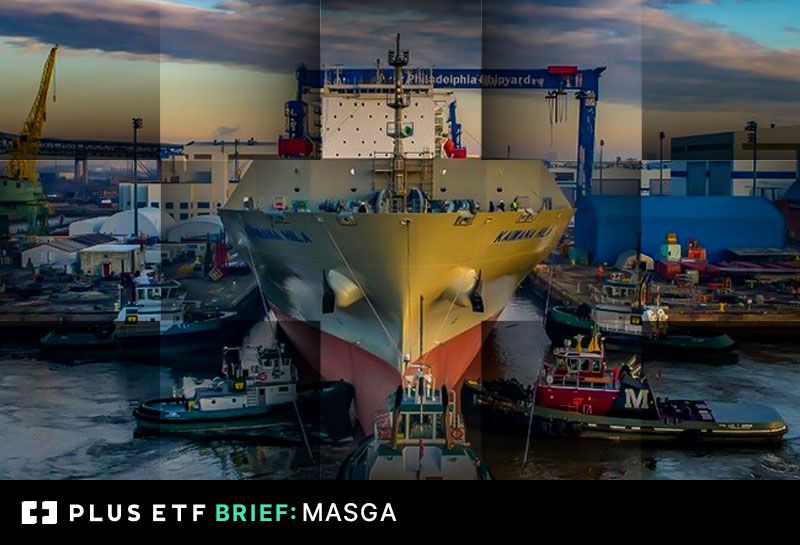 The plan, nicknamed “Make America Shipbuilding Great Again” (MASGA), is a proposed $150 billion initiative to pour capital, technology, and training into U.S. shipbuilding. [1] For Korea, it’s a way to strengthen ties with Washington, secure more defense contracts, and showcase its world-class shipbuilding know-how. For investors, it may mean opportunities for the Plus Korea Defense Industry Index (KDEF).
Why Shipbuilding? Why Now?
South Korea already sits at the top of the global shipbuilding league. [2] In the first half of 2025, Korean yards claimed 25% of all new global orders [3], focusing on advanced ships like LNG (Liquid Natural Gas) carriers, destroyers, and auxiliaries. With LNG trade volumes projected to grow ~60% by 2040, Korea’s edge in building high-tech, high-value ships is becoming even more valuable. [4]
The U.S., by contrast, has struggled to keep up. Its naval yards are overbooked, while demand for both military and commercial ships continue to rise. MASGA is designed to fix that. One showcase deal: a major investment in Philadelphia’s shipyard, pairing Korean efficiency with American demand. Hanwha has pledged $5 billion to expand and modernize Philadelphia’s shipyard, part of South Korea’s MASGA initiative. The investment will add new docks and facilities, boost output from fewer than two ships to as many as 20 vessels annually and create thousands of U.S. jobs all while bringing Korean digital shipbuilding methods to American soil. [5]
Submarines: Silent Strength
Korea isn’t just a leader in tankers and carriers; it’s making waves under the surface too. The KSS-III submarine, built by Hanwha Ocean and HD Hyundai (both in KDEF as of 9/30/25), is packed with air-independent propulsion, lithium-ion batteries, and vertical launch systems. It can stay submerged for weeks and deploy advanced missiles. These subs are already drawing export interest in Europe and Asia, more proof that Korea is becoming a full-spectrum maritime power. [6][7]
What This Means for KDEF
For investors, the Plus Korea Defense Industry Index (KDEF) may offer a way to tap into these themes. Here’s why MASGA could matter:
- Reliable export revenues. Korea booked $17.3B in defense exports in 2022, ~$13.5B in 2023, and ~$9.5B in 2024 and the Defense Acquisition Program Administration is cautiously eyeing a $23 billion goal this year. [8] The flow continues: Korea Aerospace Industries (held in KDEF as of 9/30/25) recently sealed a $700M FA-50 fighter deal with the Philippines. [9]
- Bigger, stickier contracts. Shipyard partnerships mean not just ship sales, but also modules, integration, and decades of maintenance which means steady revenue.
- Maritime security tailwinds. From LNG logistics to undersea deterrence, global demand for sophisticated vessels keeps rising and Korea is already positioned as the go-to builder.
KDEF, which invests at least 80% of its assets in defense-linked firms and rebalances quarterly, aims to capture exposure to these companies as they potentially secure export contracts, expand in the U.S., and may benefit from rising geopolitical demand.
Strategic Outlook
MASGA isn’t just a catchy slogan - it’s South Korea’s attempt to align its industrial muscle with America’s naval needs. If the initiative takes hold, Korean defense firms could potentially see years of growth fueled by exports, U.S. partnerships, and global maritime demand.
For investors, KDEF seeks to offer investors exposure to that story.
Peruse KDEF’s Holdings here.
[1] Reuters Staff Writers, “Make America Shipbuilding Great Again” package key to reaching trade deal, South Korea Says, Reuters, 7/31/25.
[2] Staff Writer, South Korea Becomes World’s Top Shipbuilder in January, Surpassing China, Marine Insight, 2/8/25.
[3] Maritime Executive Staff, South Korean Shipbuilders Report Strong H1 as Orders Shift From China. The Maritime Executive, 7/29/2025.
[4] Rashad, Marwa & Chow, Emily, Shell Expects 60% Rise In Global LNG Demand by 2040 as Asia Leads Growth, Reuters, 2/25/25.
[5] Ballinger Fletcher, Zita, South Korean Manufacturers Outline Plans To Bolster US Shipbuilding, Defense News, 9/16/25.
[6] Larson, Caleb, KSS-III: It Might Be One Of The Best Submarines On Earth (Not In The US Navy, National Security Journal, 5/30/25.
[7] Min-Kyung, Jung, From tanks to submarines: South Korea deepens defense footprint in Poland, The Korea Herald, 9/8/25.
[8] Min-Kyung, Jung, From ashes of war to arsenal of world: South Korea’s defense industry boom, The Korea Herald, 8/14/25.
[9] Reuters Staff Writers, South Korea’s KAI signs $700 mln aircraft deal with Philippines, Reuters, 6/4/25.
Investors should consider the investment objectives, risks, charges and expenses carefully before investing. For a prospectus or summary prospectus with this and other information about the Fund, please call 1-855-900-0030 or visit our website at www.plusetf.com. Read the prospectus or summary prospectus carefully before investing.
Holdings are subject to change. For current holdings go to www.plusetf.com.
The Fund is distributed by Foreside Fund Services, LLC and Exchange Traded Concepts, LLC serves as the investment advisor of the funds. Foreside Fund Services, LLC is not affiliated with Exchange Traded Concepts, LLC or any of its affiliates.
Risk Disclosures:
Investing involves risk, including possible loss of principal. There is no guarantee the Fund will achieve their stated objectives. In addition to the normal risks associated with investing, international investments may involve the risk of capital loss from unfavorable fluctuation in currency values, differences in generally accepted accounting principles or social, economic or political instability in other nations. Emerging markets involve heightened risks related to the same factors as well as increased volatility and lower trading volume. The Fund’s concentration in an industry or sector can increase the impact of, and potential losses associated with, the risks from investing in those industries/sectors.
The Fund’s concentration in a single country or a limited number of countries will increase the impact of, and potential losses associated with, the risks from investing in those countries.
The Fund is non-diversified. The Fund is new and has a limited operating history for investors to evaluate. A new and smaller fund may not attract sufficient assets to achieve investment and trading efficiencies. In addition to the normal risks associated with investing, investments in smaller companies typically exhibit higher volatility.
The Fund may invest in securities denominated in foreign currencies. Because the Fund's NAV is determined in U.S. dollars, the Fund's NAV could decline if currencies of the underlying securities depreciate against the U.S. dollar or if there are delays or limits on repatriation of such currencies. Currency exchange rates can be very volatile and can change quickly and unpredictably.
The Fund is a recently organized investment company with no operating history. As a result, prospective investors have no track record or history on which to base their investment decision. Moreover, investors will not be able to evaluate the Fund against one or more comparable funds on the basis of relative performance until the Funds has established a track record.
One basis point (bps) is equivalent to 0.01%.


